
If you're moving back to India after years abroad and qualify for the RNOR status, this module is for you and everything that becomes important due to this move. Your foreign brokerage account, your retirement savings, your RSUs, the property you may own abroad; each piece has its own rules and its own timeline that becomes critical for the future of these entities.
Moving back to India doesn't force you to withdraw or close a foreign retirement account. It stays with your provider, continues to grow, and remains yours to manage from India, the same baseline as your brokerage holdings from the last chapter.
Most retirement accounts require local earned income to contribute to them, a paycheque taxed in that country. Once you've moved back and your income is Indian, you generally can't add fresh contributions to a foreign retirement account, regardless of your residency or RNOR status. The account keeps growing on what's already inside it, but the door to adding more closes the moment your income source changes.
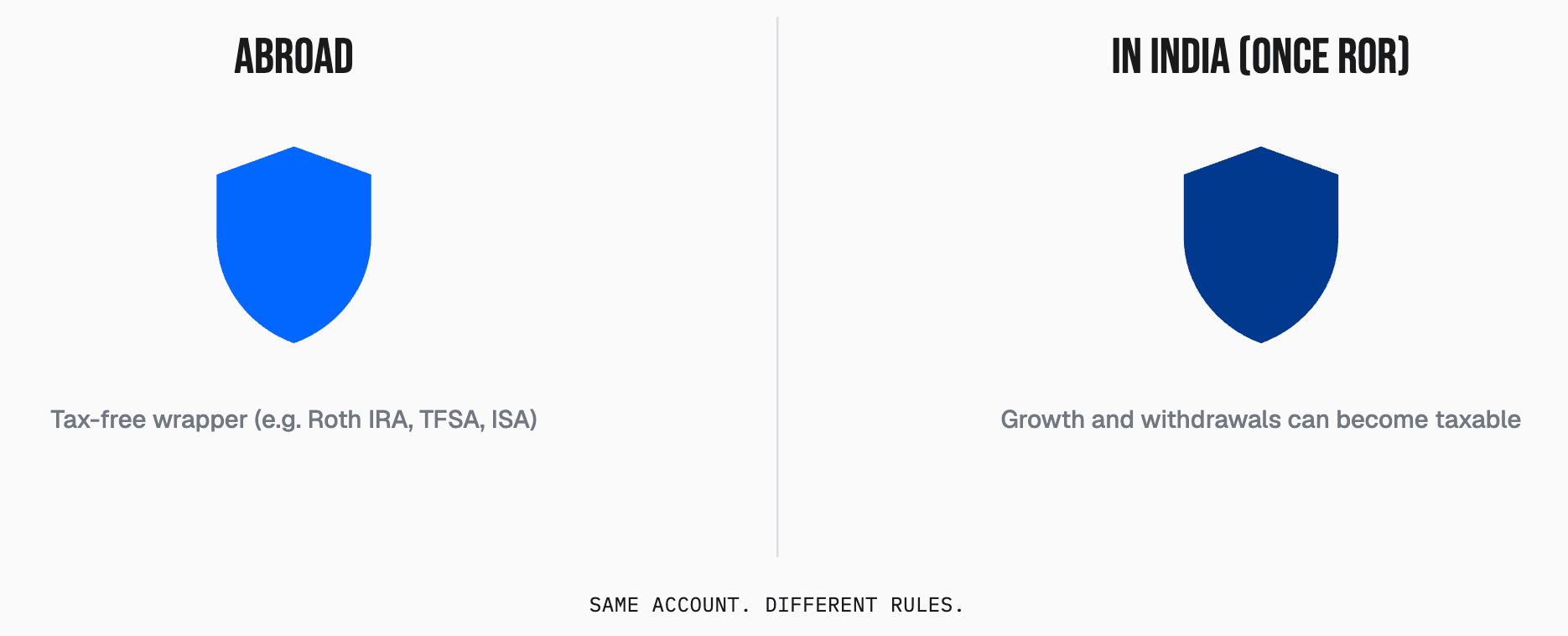
If your retirement account was structured as tax-free in its home country, a Roth IRA, an ISA, or a TFSA, that tax-free status was granted by that country's law. India doesn't recognize it. Once you're a full Ordinary Resident, growth and withdrawals from an account that was completely tax-free abroad can become taxable in India, because India applies its own rules to the underlying income and gains, not the foreign wrapper built around them.
For regular pension payments specifically, most of India's tax treaties give primary taxing rights to your country of residence, generally where you're currently living, rather than to India.
Where India also has some claim, the DTAA mechanism from earlier in this course, a foreign tax credit, prevents the same pension income from being taxed twice.
The specifics vary by treaty and by account type, but the underlying logic is the one you already know: whichever country taxes first, the other gives credit rather than taxing again from scratch.
During RNOR, foreign income is exempt in India provided it's received into a foreign account first. For retirement accounts specifically, particularly ones taxed heavily at the point of withdrawal in their home country, a 401(k), an RRSP, similar accounts elsewhere, this often turns out to be the single most valuable benefit RNOR offers.
A large withdrawal that would otherwise face Indian tax on top of whatever the source country already takes, faces none from India at all, as long as it lands in your foreign account first and RNOR still holds.
If you're planning a significant withdrawal at some point regardless, timing it within your RNOR window rather than after it ends can be worth a meaningful sum, purely through avoiding a second layer of Indian tax on money the source country has already taxed.
If your retirement account is US-based, a 401(k) holding US assets, it's worth knowing this sits inside the same US estate tax exposure you may have already met elsewhere in this course, non-residents face a low exemption and rates up to 40% on US-situated assets.
Unlike an ordinary brokerage holding, where switching to a non-US-domiciled fund is a straightforward fix, a retirement account's structure doesn't offer that same flexibility, you can't simply swap what a 401(k) holds for a differently-domiciled equivalent the way you could with a discretionary investment.
This is a real, harder-to-solve exposure for large US retirement balances, and it's worth factoring into broader estate planning rather than assuming there's a simple structural workaround available.
Your foreign retirement account generally stays put, growing without fresh contributions, taxed according to DTAA rules once regular payments begin, and untouched by India's foreign-wrapper recognition gap only until you're no longer RNOR.
The single biggest lever available to you is timing any large withdrawal to land inside the RNOR window rather than after it. The next chapter turns to a different, more technical mechanic entirely: what happens to RSUs that are still vesting when you move.



Discussion