
If you're moving back to India after years abroad and qualify for the RNOR status, this module is for you and everything that becomes important due to this move. Your foreign brokerage account, your retirement savings, your RSUs, the property you may own abroad; each piece has its own rules and its own timeline that becomes critical for the future of these entities.
If your foreign property is rented out, the source country typically withholds tax on that rent at the point it's paid, often a flat rate on the gross amount, with few deductions allowed. That's the foreign side, and it applies regardless of your Indian status.
The India side follows the master rule you've now seen apply to nearly every foreign income stream in this module. During RNOR, foreign rental income is not taxed in India at all, provided the rent is received into your foreign account first, not sent directly into an Indian one.
Once you become a full Ordinary Resident, that same rental income becomes taxable in India, with the DTAA mechanism giving you credit for whatever tax the source country already withheld, so you're not taxed twice on the same rent, just taxed once by India for the first time.
Selling foreign real estate typically triggers a withholding requirement at closing in the source country, and it's worth understanding that this withholding is not your final tax bill, it's a security deposit against it.
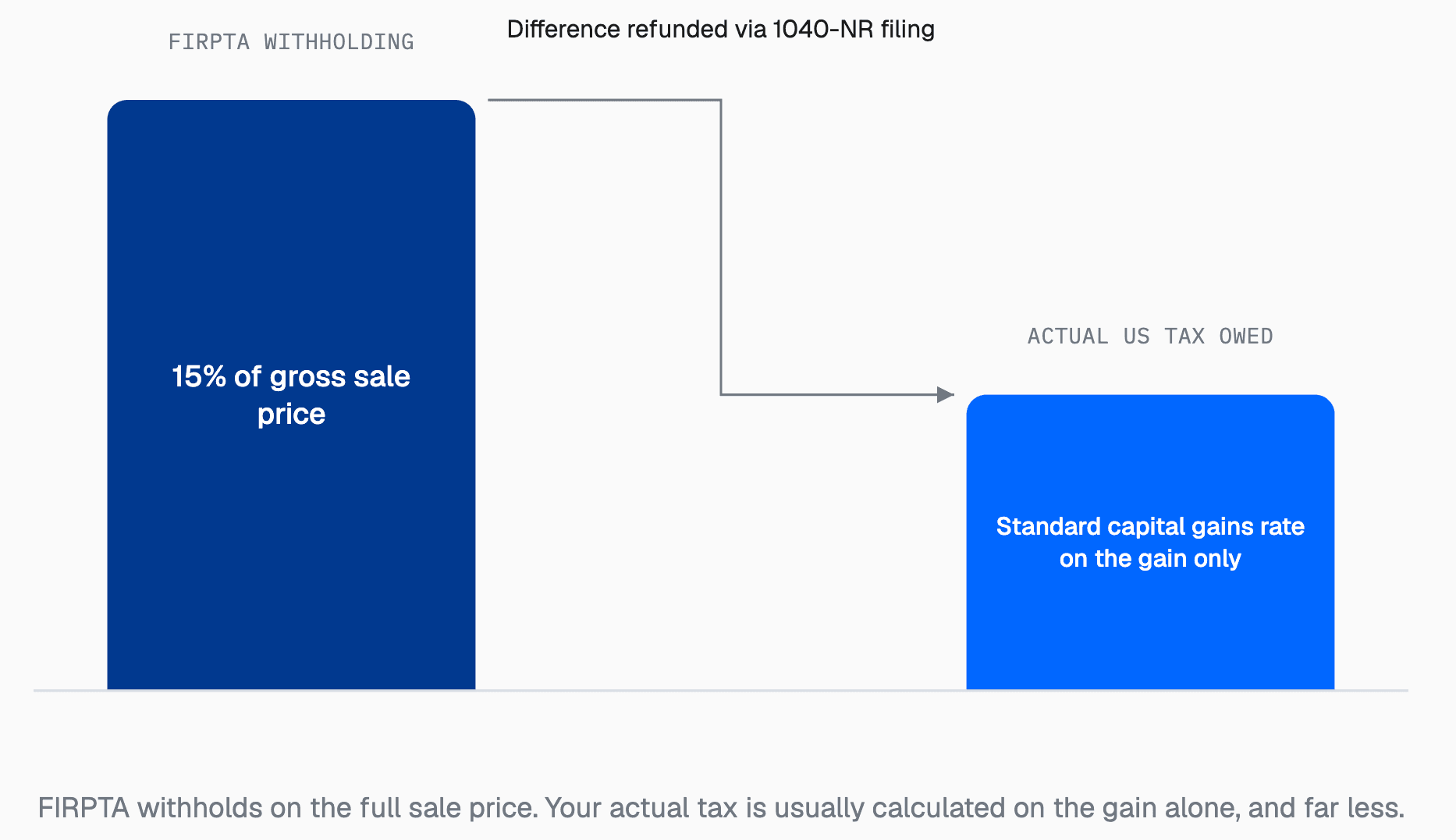
Using the US as the clearest example, FIRPTA requires the buyer to withhold up to 15% of the gross sale price, not the gain, the full price, the moment a non-resident sells US property. Certain lower-value sales used as the buyer's residence can qualify for reduced or zero withholding, but the general default is that a meaningful chunk of your sale proceeds gets held back immediately.
Your actual US tax liability is usually far less than that 15%. Long-term capital gains on real estate are taxed at standard rates, 0%, 15%, or 20% depending on your income, not the flat 30% many people assume applies to non-residents. The way you recover the difference is by filing a US non-resident tax return after the year ends, reconciling the amount withheld against what you actually owed, and claiming back the excess.
On the Indian side, the rule is the same one you've now seen repeatedly: while you're an NRI or RNOR, India taxes none of the gain on selling foreign property. Once you become a full Ordinary Resident, the gain becomes taxable in India.
Selling while you're still outside India, or during your RNOR window after returning, means India takes none of the gain. Selling after RNOR ends means the same gain is now fully taxable in India, on top of whatever the source country already withheld and reconciled.
The property itself hasn't changed. The only variable is which side of the RNOR line the sale falls on, and that's entirely within your control to plan around.
The same repatriation discipline from earlier chapters applies here with real stakes attached. Sale proceeds should move from the source-country account into your own foreign bank account first, and only then, separately, into your NRE account in India.
Sending the proceeds directly from the buyer or the closing agent into an Indian account risks having that money treated as income received in India, which can undo the RNOR exemption you were otherwise entitled to.
US real estate is a US-situs asset for estate tax purposes, sitting inside the same low exemption and steep rate structure that applies to US stocks and retirement accounts. For a large US property held long-term, this is worth factoring into your broader planning, not just the income and sale tax questions this chapter has focused on.
Foreign property follows the module's now-familiar pattern, rental income and sale gains both exempt in India during RNOR, provided the money is received abroad first, taxable once you're a full resident.
The actionable insight is timing because source-country withholding is a deposit against your real liability, and India takes nothing during RNOR, selling inside that window rather than after it can meaningfully change your outcome. The next chapter turns to a risk sitting at the opposite end of your timeline entirely, one that can apply before you've even left your host country: exit tax.



Discussion