
If you're moving back to India after years abroad and qualify for the RNOR status, this module is for you and everything that becomes important due to this move. Your foreign brokerage account, your retirement savings, your RSUs, the property you may own abroad; each piece has its own rules and its own timeline that becomes critical for the future of these entities.
Every chapter so far has covered what happens once you're back in India. This chapter covers something that happens on the other end of your timeline, before you've even landed, and the trigger is different depending on which country you're leaving.
Canada taxes are based on residency, not citizenship. The moment you cease to be a Canadian tax resident, it applies deemed disposition: treating you as having sold most of your capital property at fair market value on your departure date, and taxing the resulting gain, even though nothing was actually sold. Only the growth that happened while you were a Canadian tax resident is caught, not what accrued before you arrived or after you left. Say you held a fund worth ₹30 lakh on the day you became a Canadian tax resident, and it had grown to ₹40 lakh by the day you left, Canada's deemed disposition captures tax on that ₹10 lakh, and nothing else.
This applies to anyone who was a genuine Canadian tax resident, a broader group than just citizens or permanent residents, it's a facts-and-circumstances test based on your ties to Canada, not your visa category. The filing itself, Forms T1161 and T1243 alongside your final Canadian return, carries real penalties for skipping it, generally CAD 2,500 to 10,000, even in years no tax actually ends up being owed.
Australia's version, CGT Event I1, works on the same basic logic: the moment you cease to be an Australian tax resident, you're deemed to have disposed of most of your non-Australian assets, shares, foreign property, cryptocurrency, at market value on that date, with the resulting gain or loss included in your final Australian tax return. Assets that count as "taxable Australian property," Australian real estate, mining rights, interests in an Australian business, are excluded entirely and simply stay in Australia's tax net regardless of your residency.
The genuine difference from Canada is that you get a real choice. You can accept the deemed disposal and pay the tax now, often at a reduced rate since a 50% CGT discount applies to assets held more than 12 months, or you can formally elect to defer it, in which case the affected assets remain connected to Australian capital gains tax until you actually sell them or become an Australian resident again. This election applies to every affected asset together.
The US equivalent, under Internal Revenue Code Section 877A, applies only to a specific group: people giving up US citizenship, or relinquishing long-term green card status. It does not apply to someone who worked in the US on an H-1B, L-1, or similar visa and simply leaves without ever having held a green card.
If you are giving up a green card you've held long enough to qualify as a "long-term" holder, generally 8 of the past 15 tax years, or renouncing citizenship, and you meet certain thresholds, broadly a net worth above roughly USD 2 million among other tests, you may be classified as a "covered expatriate" and become subject to this tax, which works similarly to Canada and Australia's versions: a deemed sale of your global assets on the day before you formally exit. Form 8854 has to be filed to document the departure properly. For the majority of Indian professionals who worked in the US on a temporary visa and never held a green card, this entire regime simply doesn't apply, no deemed sale, no Form 8854, nothing to plan around here.
The UK works differently from all three of the above. It doesn't tax you on departure at all. Instead, it has a rule called Temporary Non-Residence, triggered not by leaving but by returning too soon. If you were a UK tax resident for at least 4 of the 7 tax years before you left, and you return to the UK within 5 years, gains on assets you already owned before leaving, sold while you were non-resident, become taxable in the UK retroactively, in the tax year you return. Assets bought and sold entirely during your time abroad aren't caught, only ones you held before departure. Stay non-resident for more than 5 full tax years, and none of this applies, the gains stay outside UK tax permanently. For anyone returning to India from the UK, this timing is worth checking deliberately before selling anything, not assumed either way.
One practical point worth knowing, even if none of the above applies to your situation. Indian tax authorities may ask for evidence that you properly settled your exit formalities in the country you left, a tax residency certificate, proof of a final departure filing, or similar documentation. If the departure country's paperwork was left incomplete, that gap can complicate or delay treaty-based claims you make later in India, even on matters unrelated to exit tax itself.
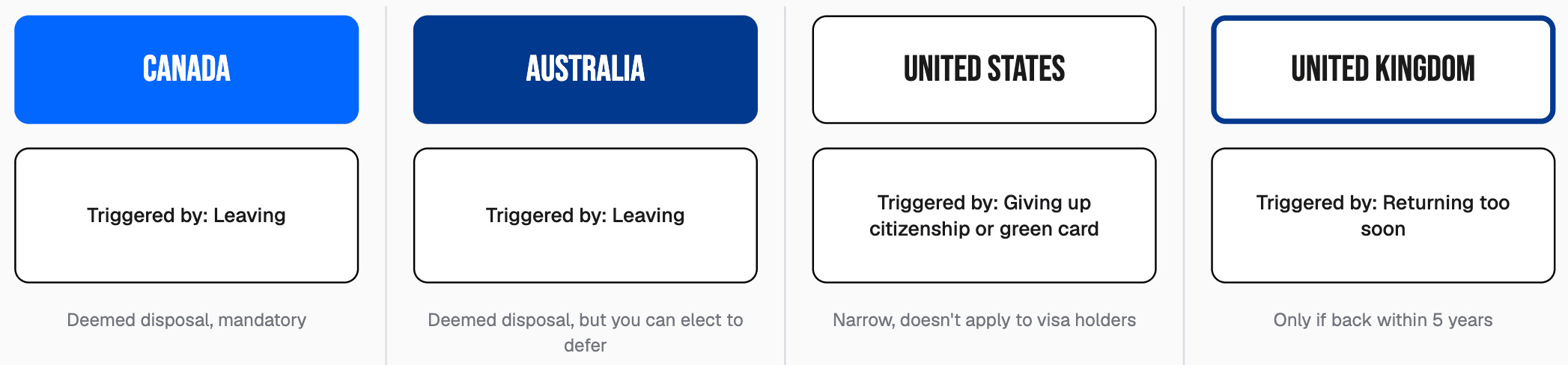
Four countries, four genuinely different mechanisms. Canada taxes you on departure with no choice in the matter. Australia does the same but lets you elect to defer. The US only catches those relinquishing citizenship or a long-term green card, not ordinary visa holders. The UK taxes nothing on the way out but claws back gains if you return within five years. Check which, if any, actually applies to your specific status and departure country, rather than assuming any of these rules mirror each other. With this final risk now on the table, the next chapter turns to what changes once your RNOR window closes for good.



Discussion