
If you're moving back to India after years abroad and qualify for the RNOR status, this module is for you and everything that becomes important due to this move. Your foreign brokerage account, your retirement savings, your RSUs, the property you may own abroad; each piece has its own rules and its own timeline that becomes critical for the future of these entities.
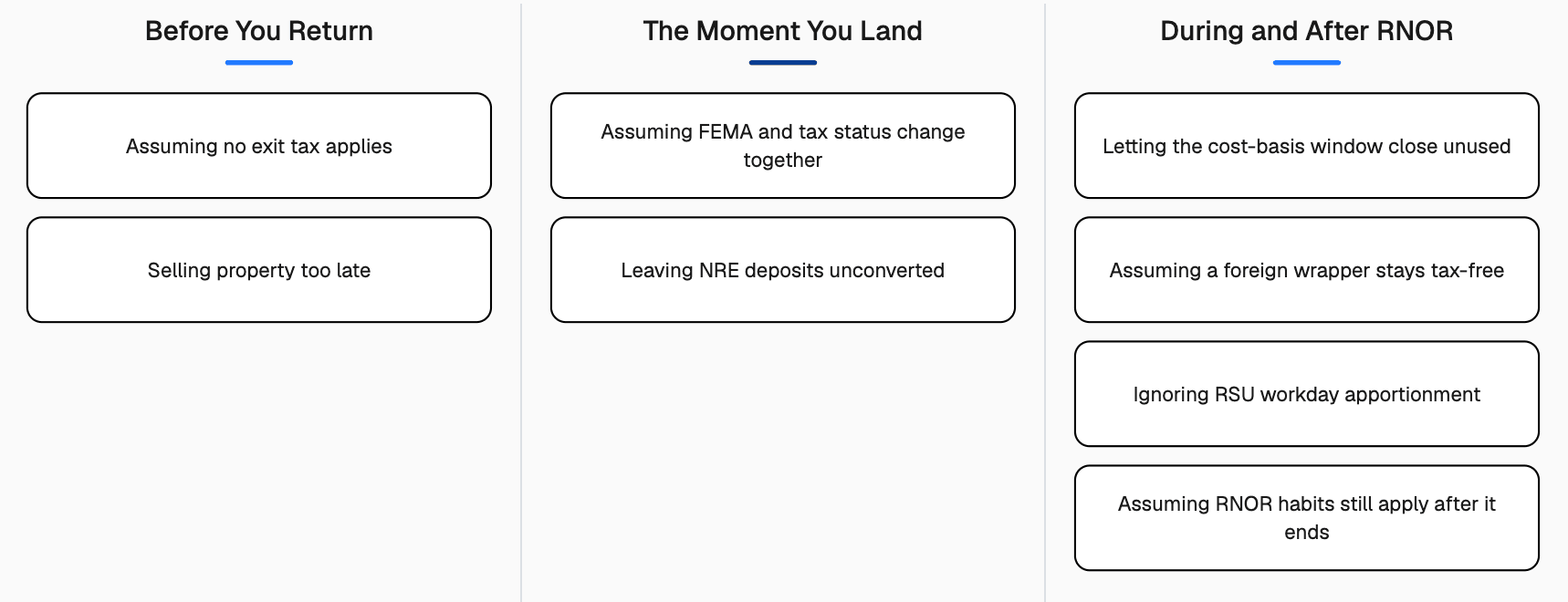
Chapter 2 established that FEMA and tax residency run on different clocks. FEMA residency changes the moment you land with intent to stay; tax residency is decided only once the year's day count is complete. Assuming both flip on the same day leads people to either convert accounts too late, breaching FEMA, or assume RNOR protections apply before they've actually qualified.
The master rule underlying nearly every benefit in this module: foreign income stays exempt during RNOR only if it's received into a foreign account first. Rent, dividends, retirement withdrawals, or sale proceeds sent directly to an Indian account lose the exemption immediately, RNOR status notwithstanding.
NRE deposit interest exemption is lost from the moment your FEMA status changes, not gradually. Delaying the conversion to a resident account or RFC means paying tax on interest that could have stayed exempt.
RFC covers current-account spending, travel, education, medical, family maintenance, without an LRS cap. It does not create extra room for fresh capital investments abroad; the standard USD 250,000 limit still applies regardless of which account funds the purchase.
Selling and repurchasing foreign stocks while still RNOR resets your cost basis tax-free. Once RNOR ends, the same move triggers full Indian capital gains tax on the entire embedded gain. This window doesn't reopen.
A Roth IRA, TFSA, or ISA being tax-free abroad generally doesn't carry that status into India. Once you're a full resident, growth and withdrawals from these accounts can become taxable here, regardless of how they were treated in their home country.
RSUs vesting after your move are split by actual workday count across the full vesting period, not by where you happened to be on the vesting date. The India-sourced portion is taxable regardless of RNOR status, and relying on a brokerage statement instead of a proper valuation can trigger compliance problems.
Source-country withholding at sale is a deposit, not your final liability, and India taxes the gain at zero during RNOR but in full afterward. Selling the same property a year too late can mean a materially worse combined outcome.
The US exit tax applies only to those relinquishing citizenship or long-term green card status, not to someone who simply worked in the US on a temporary visa. Conversely, Canada's deemed disposition applies broadly to anyone who was a genuine Canadian tax resident, regardless of citizenship, and carries real filing penalties even when no tax is owed.
RNOR ends based on your own rolling residency count, not a fixed date, and once it does, Schedule FA disclosure switches on and worldwide income becomes fully taxable. Continuing to treat foreign holdings as exempt after crossing into full residency is a straightforward, avoidable error.



Discussion