
NRI taxation in India isn't a simple variation of regular taxation. It's a different rulebook, built on a different core principle, and trying to apply resident rules to an NRI situation gets things wrong in ways that are easy to miss and expensive to discover late.
When a resident earns income in India, tax is generally withheld at a rate that roughly tracks their eventual liability, adjusted for the basic exemption and their circumstances. For an NRI, it works differently, and deliberately so.
Tax Deducted at Source on payments to a non-resident is applied at heavy, largely flat rates, none of the basic exemption slab that residents benefit from is applied at the point of deduction.
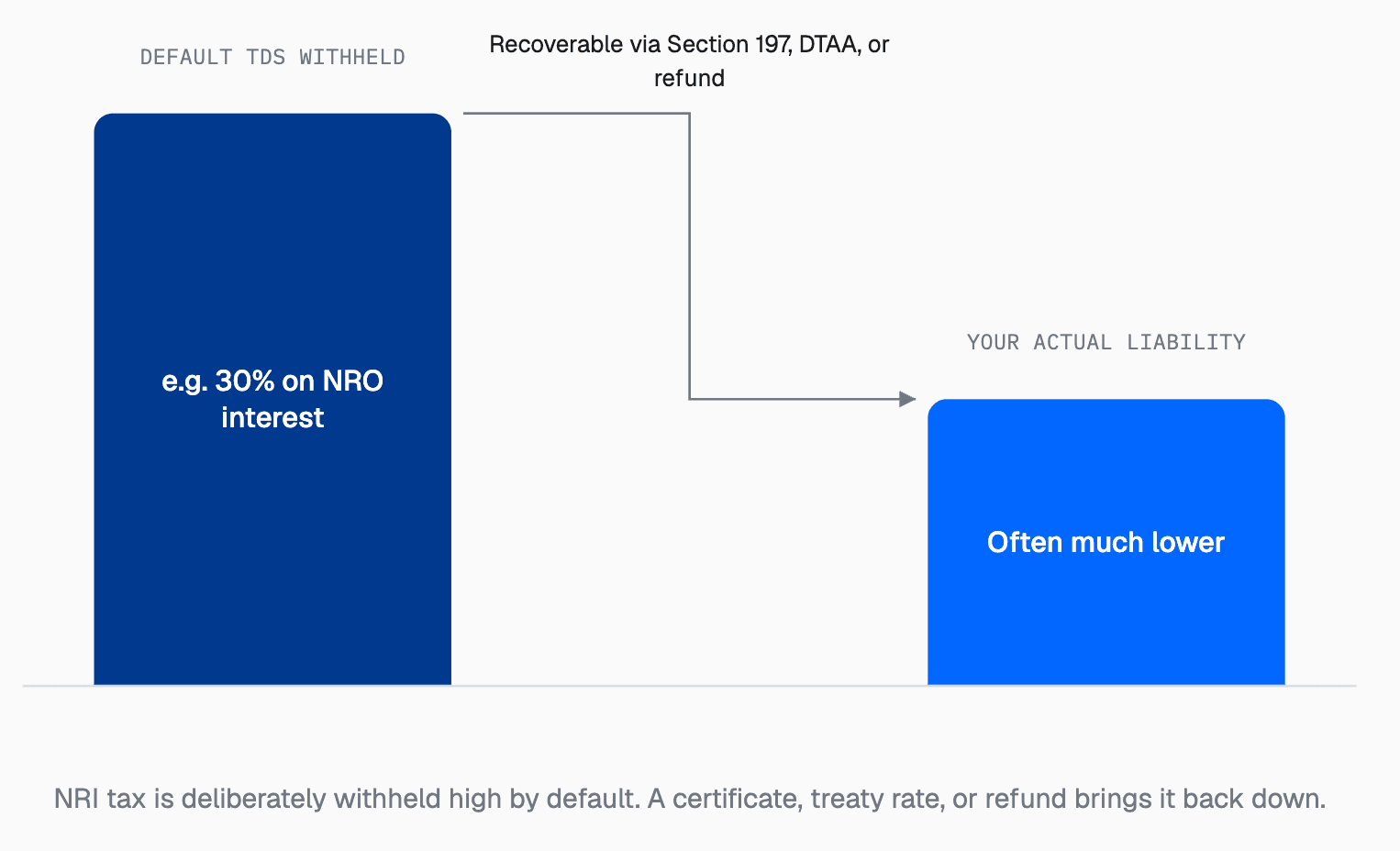
The reasoning is straightforward: once money and the person receiving it can be anywhere in the world, following up after the fact to collect unpaid tax becomes far harder. So India collects aggressively upfront and leaves reconciliation, getting back whatever was over-withheld, to you.
In practice this shows up as steep numbers. Rental income is typically withheld around 31.2%. Interest on an NRO account faces 30% TDS. Dividends face 20%. Capital gains withholding varies by asset type and holding period, but can run well into double digits regardless of what your actual tax liability turns out to be once your full financial picture is considered.
None of this means you're stuck overpaying by default. Two specific mechanisms exist, aimed at two different kinds of income.
For a one-off, lump-sum transaction (like selling a property, receiving a large rent payment) you can apply to the tax department in advance for a lower or nil deduction certificate under Section 197, using Form 13. You lay out your actual income, deductions, and expected tax liability, and if the assessing officer agrees your real liability is below the default withholding rate, they issue a certificate instructing the payer to deduct at the lower rate instead. This has to be arranged before the transaction, not after.
For recurring income (dividends, interest, and similar streams that arrive repeatedly rather than as a single event) the more relevant tool is claiming your DTAA rate directly. If India has a tax treaty with your country of residence, that treaty often specifies a lower withholding rate than India's standard TDS. To access it, you provide the payer with a Tax Residency Certificate from your country of residence's tax authority, along with Form 10F, and the payer can then withhold at the treaty rate from the start rather than the higher domestic default.
Even with these tools, TDS often doesn't land exactly on your true liability, sometimes it's still too high, especially if you didn't arrange the paperwork in time.
The reconciliation happens the same way it would for anyone: file an Indian income tax return.
If the tax withheld exceeds what you actually owed once your full income and any treaty benefits are properly accounted for, the difference comes back as a refund. This is also why it's worth filing even in years your Indian tax liability turns out to be genuinely low or nil, since a return is often the only way to actually recover excess TDS rather than simply losing it.
NRI taxation runs on a heavier, front-loaded withholding system by design. With taxation now covered, the next chapter turns to the practical mechanics of moving that money, the repatriation rules that govern how it actually gets from your Indian accounts back abroad.
One question. Less than 10 seconds.
Reinforce what you've learned before continuing to the next chapter.