
NRI taxation in India isn't a simple variation of regular taxation. It's a different rulebook, built on a different core principle, and trying to apply resident rules to an NRI situation gets things wrong in ways that are easy to miss and expensive to discover late.
We know about a hard ceiling: the USD 250,000 annual limit under the Liberalised Remittance Scheme, the cap on how much a resident Indian can send abroad each year. As an NRI, that limit governs someone else's money, not yours.
The Liberalised Remittance Scheme exists to let a resident Indian send a portion of their own worldwide income abroad, for investment, travel, education, and similar purposes, within an annual cap.
Now recall the core rule from earlier in this journey. As an NRI, your foreign-sourced income was never inside India's system to begin with. Most of the time it simply stays in a foreign bank account, never touching India at all, though some of it may also sit in your NRE or FCNR account back home, tax-free either way, entirely outside India's tax net.
Moving that money, whether from your NRE account back abroad, or simply between two foreign accounts you hold in your country of residence, isn't "sending Indian money abroad" in the sense LRS was built to regulate. It's simply moving your own foreign money between accounts that already sit outside India's worldwide-income claim, none of which ever entered the system LRS governs in the first place.
For your own foreign-sourced funds, held in NRE or FCNR accounts, there is no LRS ceiling to work around. Repatriation is governed by the specific rules for those accounts, which you met in the last chapter, generally full and free repatriation, not by the $250,000 figure that dominates resident planning.
Where a limit does reappear is on the NRO side, and it's worth being precise about why, since it isn't actually LRS at all, even though people sometimes describe it that way.
Repatriating money from an NRO account, which holds India-sourced income, carries its own cap, generally up to USD 1 million per financial year, alongside the tax documentation from the last chapter. That's a separate rule, tied to the account holding India-sourced money, not the LRS scheme built for resident remittances.
The two limits look superficially similar, both are dollar figures capping outward movement, but they exist for entirely different reasons and apply to entirely different pools of money.
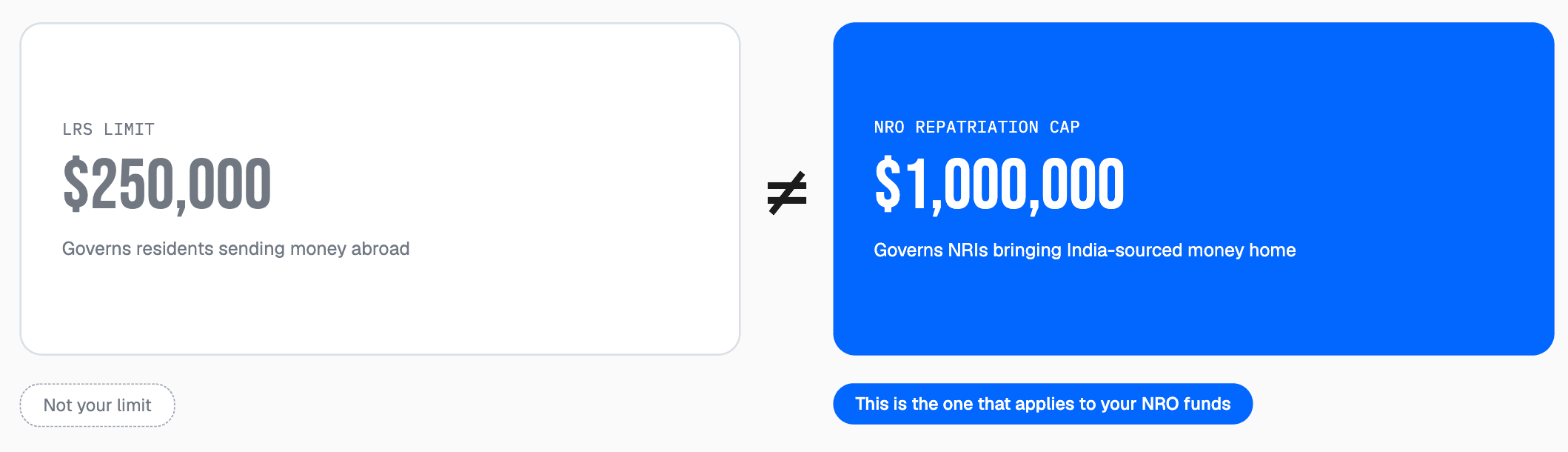
It's an easy mistake to make, especially for anyone who was a resident investor before becoming an NRI, or who has read general content aimed at residents. Assuming LRS still applies can lead to needlessly conservative planning, holding back on moving your own money because of a ceiling that was never yours to begin with. It can also lead to the opposite error, assuming every outward-money question has some 250,000 dollar answer, when the real answer depends entirely on which account, and which income, is actually involved.
LRS is a resident scheme, built to regulate how much of a resident's worldwide income can leave India. As an NRI, your foreign-sourced money was never inside that system, so the limit simply doesn't apply to it.
The number that matters for you, if any, depends on which account you're moving money from, NRE and FCNR largely unrestricted, NRO capped and documented. With the account structure and this misconception both cleared up, the next two chapters turn to the actual investing itself, starting with how NRIs invest into India.
One question. Less than 10 seconds.
Reinforce what you've learned before continuing to the next chapter.