
NRI taxation in India isn't a simple variation of regular taxation. It's a different rulebook, built on a different core principle, and trying to apply resident rules to an NRI situation gets things wrong in ways that are easy to miss and expensive to discover late.
An ordinary resident demat and trading account is off-limits once you're an NRI. Everything you invest in India has to run through the NRI account structure instead, and the single most consequential choice you make at setup is which side of that structure you fund from, NRE or NRO.
Fund an investment from your NRE account, and it's repatriable: both what you put in and whatever it earns can move freely back abroad.
Fund it from your NRO account, and repatriation works differently. The money isn't locked in, it's simply capped: up to USD 1 million per financial year, and only after the tax documentation from the last chapter (Forms 15CA and 15CB) confirms the applicable tax has been paid.
Investing directly in listed Indian equity as an NRI runs through a specific, RBI-regulated mechanism called the Portfolio Investment Scheme, or PIS. You can't simply open a demat account and start trading the way a resident does.
A PIS account, linked to your NRE or NRO account, is required, and every trade made through it is reported to the RBI.
In practice, almost everyone uses NRE-PIS, since it makes the investment repatriable, exactly the outcome most NRIs want for money they're actively choosing to invest. An NRO-linked PIS account exists too, but it offers no real advantage over simply investing without PIS from an NRO account, so it's rarely used in practice.
PIS applies specifically to direct equity trades, buying individual listed shares, not to mutual funds. As an NRI, you can invest in Indian mutual funds through either your NRE or NRO account, after completing NRI-specific KYC, with no PIS account required at all.
For most NRIs, that makes mutual funds the simpler route. If you're a US taxpayer, a citizen, green card holder, or otherwise a US tax resident, it's the opposite, and worth knowing before you invest, not after.
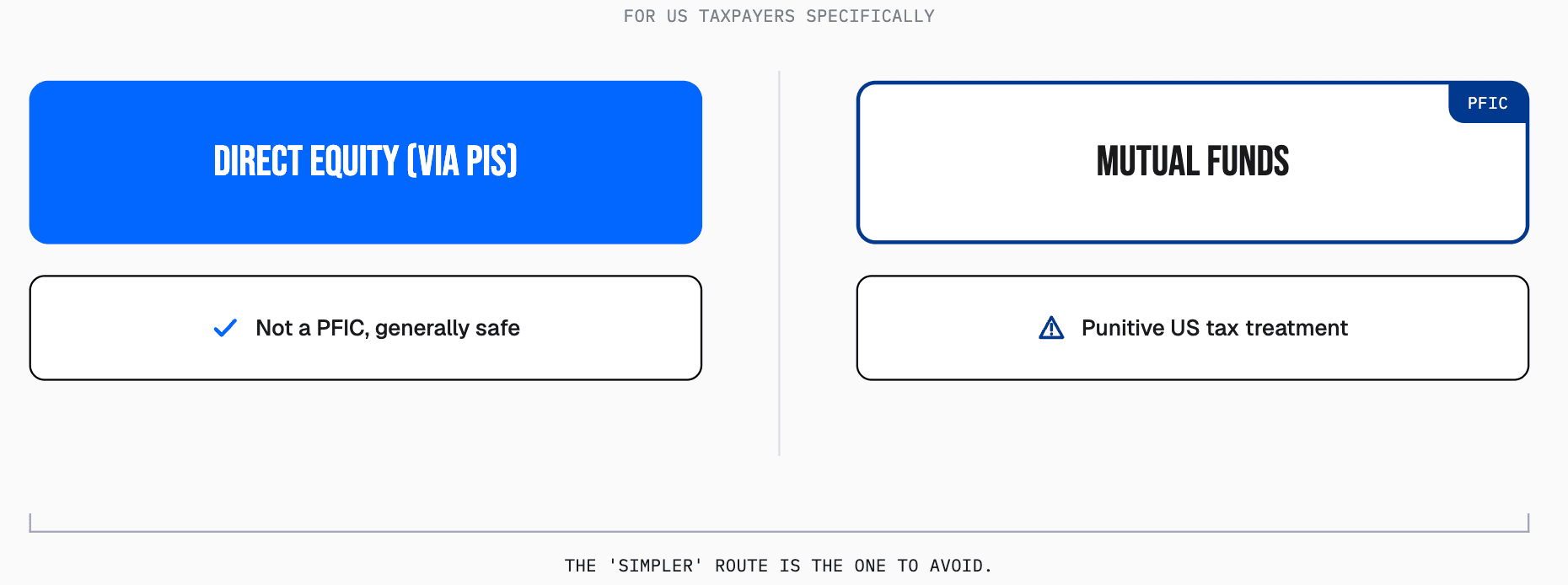
The US treats Indian mutual funds as PFICs, a category of foreign investment it taxes punitively and requires complex annual reporting on, fund by fund. Individual stocks don't fall into this category at all. So for a US taxpayer specifically, direct equity through PIS is usually the safer, simpler choice, and mutual funds are the one to actively avoid. If you're already holding Indian mutual funds as a US taxpayer, this is worth a conversation with a cross-border tax professional sooner rather than later.
Here's a genuinely useful, specific fact many NRIs only discover after being turned away. Accepting investment money from US or Canada-resident NRIs brings real compliance costs for Indian fund houses, driven by FATCA and similar reporting regimes in those countries. Many Indian AMCs have simply decided the burden isn't worth it, and decline applications from NRIs based in the US or Canada.
Gains on Indian stocks and mutual funds are taxed under the same domestic capital gains regime that applies to resident investors, this is Indian-sourced income. A later chapter covers NRI taxation properly; for now, it's enough to know that investing into India doesn't come with a separate, lighter tax regime just because you're an NRI.
Investing into India as an NRI runs through the account structure you already know, NRE for repatriable, NRO for non-repatriable, with PIS layered on top specifically for direct equity, and mutual funds reachable without it. The next chapter concerns not money coming into India, but the foreign investments and accounts you're managing, or continuing to manage, from abroad.
One question. Less than 10 seconds.
Reinforce what you've learned before continuing to the next chapter.