
NRI taxation in India isn't a simple variation of regular taxation. It's a different rulebook, built on a different core principle, and trying to apply resident rules to an NRI situation gets things wrong in ways that are easy to miss and expensive to discover late.
The last chapter covered money flowing into India. This chapter revolves around the investments you hold, or want to hold, outside India, in the country where you actually live.
Once you're an NRI, buying US stocks, UCITS ETFs, or any other foreign investment is governed by the rules of wherever you live, using whatever local brokerage or platform is normal there. If you're living in the US and want to buy US ETFs, you simply do what any local investor does.
You may be carrying a specific tax-focused worry into this chapter: that holding foreign brokerage accounts and investments means an annual Schedule FA disclosure obligation to India.
The good thing is it doesn't apply to you. Schedule FA disclosure is a requirement specifically for taxpayers classified as Resident and Ordinarily Resident. NRIs are explicitly exempt. Your foreign brokerage account, your foreign shares, your foreign ETFs, none of it needs to be reported to India through Schedule FA while you remain an NRI.
If you work for a foreign employer and receive equity compensation, RSUs from a US company, for instance, the grant, vesting, and taxation of those shares follow the rules of wherever you're a tax resident, not India's.
And if you held foreign investments before you became an NRI, say you were previously a resident investor with a US brokerage account, those holdings don't automatically change character just because your status did.
What happens to them, and what changes if you eventually move back to India, is genuinely a different question, and it's the subject of a dedicated module on returning to India and the RNOR transition.
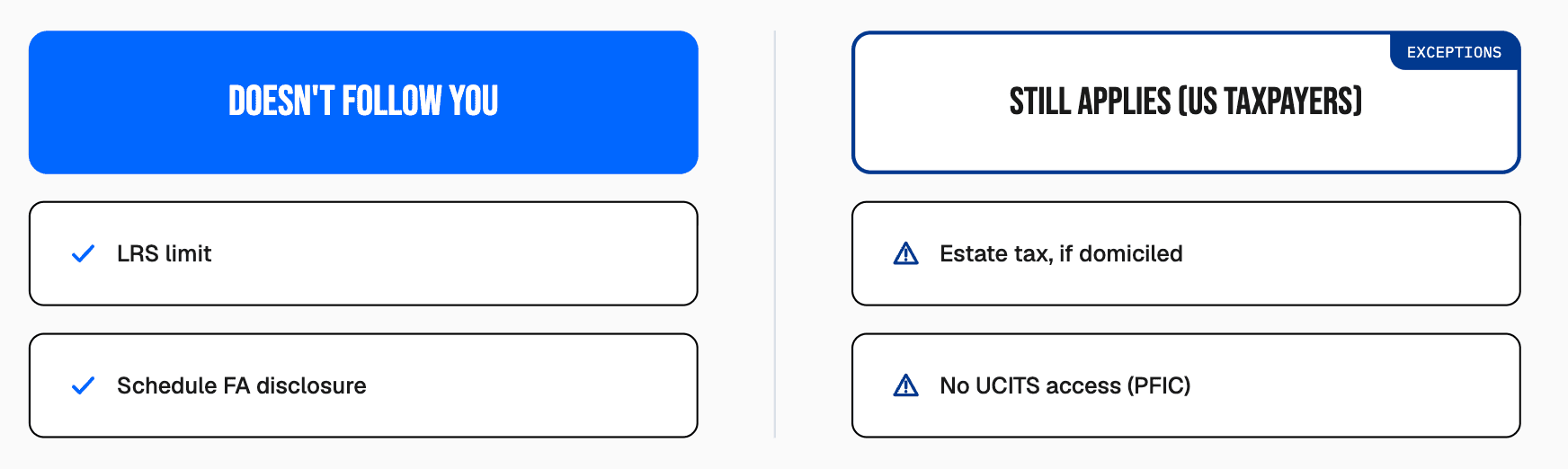
Investing abroad as an NRI is largely simple, no remittance gate, no Schedule FA.
Not for US taxpayers, though.
Estate tax exposure there hinges on domicile, not tax residency: settle in the US for good and you get the full exemption, but on your worldwide estate. If you are there on a visa with no permanent residency, you stay under the narrower $60,000 threshold on US assets only.
And UCITS, the usual workaround, isn't available to you either, most funds exclude US persons, and even where they don't, US tax law treats it as a PFIC.
Next, the tax mechanics themselves: how India taxes your India-sourced income, and how the DTAA stops you being taxed twice on it.
One question. Less than 10 seconds.
Reinforce what you've learned before continuing to the next chapter.