
NRI taxation in India isn't a simple variation of regular taxation. It's a different rulebook, built on a different core principle, and trying to apply resident rules to an NRI situation gets things wrong in ways that are easy to miss and expensive to discover late.
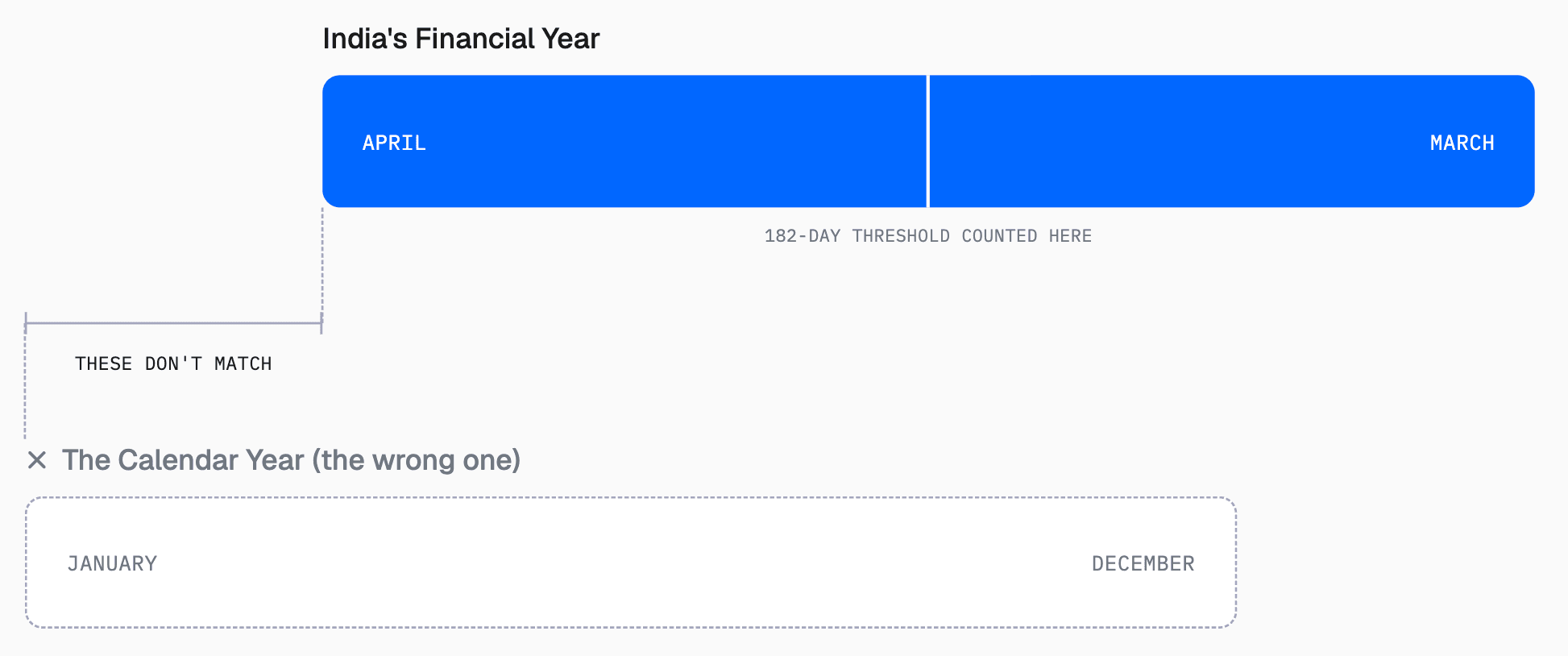
If you live outside India, whether you moved for work, study, or simply life, you may already be an NRI under Indian tax law. The rule is simple to state: if you spend fewer than 182 days in India during a financial year (April to March), you're generally a non-resident for that year, an NRI. It's a precise, countable test, not a matter of how settled you feel abroad.
NRI taxation isn't a simple variation of regular taxation. It's a different rulebook, built on a different core principle, and trying to apply resident rules to an NRI situation gets things wrong in ways that are easy to miss and expensive to discover late.
A resident Indian is taxed on worldwide income, wherever it's earned. An NRI is taxed on a completely different basis, only on income actually sourced in India.
That single rule changes nearly everything coming out of it: which of your foreign assets India even cares about, whether the LRS limit applies to you at all, which bank accounts you're permitted to hold, and how double taxation between India and your country of residence gets resolved.
Because the starting principle is different, the details built on top of it are different too, often in ways that surprise people who simply assume "NRI" just means "resident, minus a few obligations."
We will start with the mechanics: who actually counts as an NRI, the tests behind it, and the single core principle that everything else follows from.
From there, we cover the bank account structure NRIs must use instead of an ordinary resident account, and a genuinely useful fact many NRIs never learn: the LRS limit that governs resident Indians doesn't apply to you at all for your own foreign funds.
We will then move into the two directions your money can flow. Investing into India as an NRI, and continuing to invest or manage money abroad while still connected to India. From there, taxation and the DTAA that prevents you from being taxed twice on the same income, and the rules for actually repatriating money between your accounts will be covered.
We will end with understanding the mistakes NRIs make most often, and how to smartly prevent them.
One question. Less than 10 seconds.
Reinforce what you've learned before continuing to the next chapter.