
NRI taxation in India isn't a simple variation of regular taxation. It's a different rulebook, built on a different core principle, and trying to apply resident rules to an NRI situation gets things wrong in ways that are easy to miss and expensive to discover late.
Under FEMA, an NRI cannot continue operating a regular Indian savings account in their own name. It has to be converted to one of the NRI-specific account types, or closed. Continuing to use a resident account after your status changes isn't a minor oversight, it's a compliance violation. So this isn't optional infrastructure, it's the correct legal starting point the moment your residency status shifts.
There are three account types built for this, and which one holds which money is elaborated next.
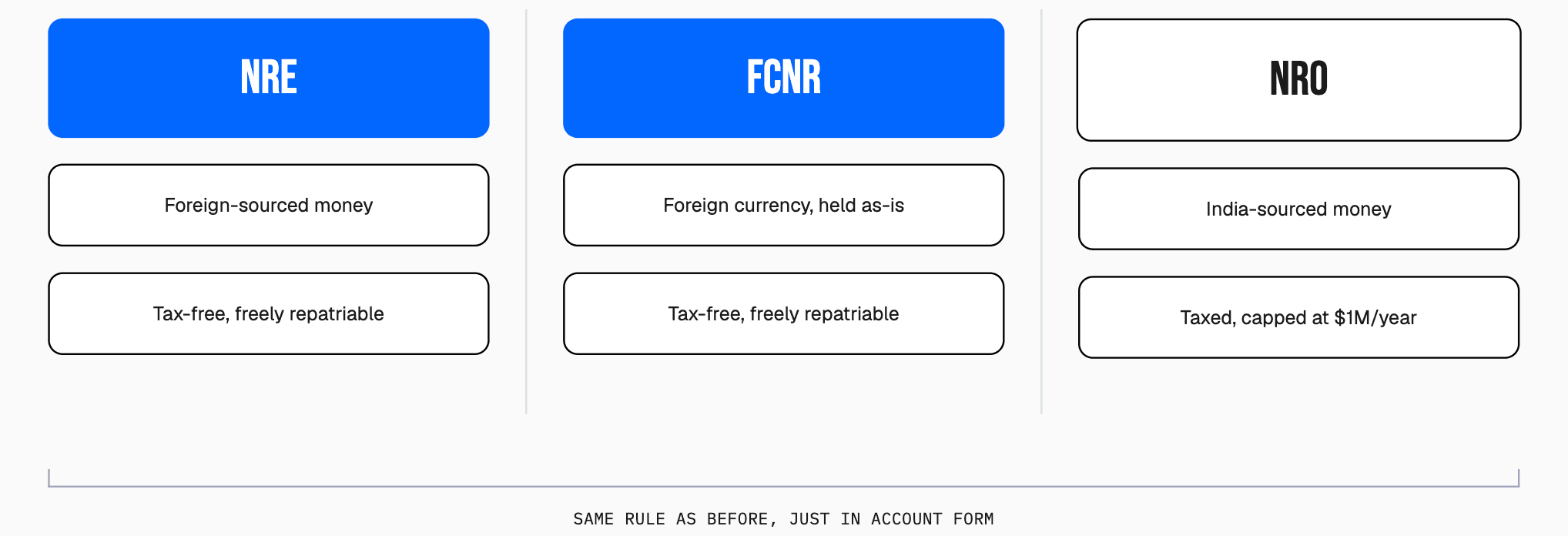
A Non-Resident External account holds money you earned abroad. You fund it with foreign currency, which the bank converts into rupees, and it can only be credited from foreign sources, transfers from abroad, or from another NRE or FCNR account. Depositing Indian-sourced income into an NRE account, rent or dividends, for instance, is a compliance red flag, because it mixes a foreign-only account with money that was never meant to sit in it.
In exchange for that discipline, an NRE account offers two real advantages. The interest earned is tax-free in India, and both the principal and interest are fully and freely repatriable, no cap, no additional paperwork, back to your foreign account whenever you choose.
A Non-Resident Ordinary account is the mirror image, built to hold income that arises in India: rent, dividends, pension, or any other India-sourced earning. Unlike an NRE account, an NRO account can be funded with both foreign remittances and Indian-sourced money, which makes it the natural home for anything that started out taxable in India anyway.
The trade-off is real. Interest earned in an NRO account is taxable in India, with tax deducted at source, and repatriating the balance out of India comes with a cap, generally up to USD 1 million per financial year, along with documentation requirements (Forms 15CA and 15CB) that confirm the applicable tax has actually been paid before the money leaves.
A Foreign Currency Non-Resident account is a term deposit held directly in a foreign currency, rather than being converted into rupees at all. This removes a risk the other two accounts carry: currency fluctuation between the time you deposit and the time you withdraw. Like an NRE account, an FCNR account is fully repatriable with tax-free interest, the difference is simply that your money never becomes rupees in the first place.
Notice the pattern. NRE and FCNR exist for the same category of money, foreign-sourced income, that sits outside India's tax reach, which is exactly why both are tax-free and freely repatriable. NRO exists for India-sourced income, which is fully taxable, which is exactly why it carries tax deduction and a repatriation cap.
Next, we turn to a genuinely useful fact many NRIs never learn: the LRS limit that governs how much a resident Indian can send abroad doesn't apply to you at all.
One question. Less than 10 seconds.
Reinforce what you've learned before continuing to the next chapter.