
Global investing carries costs beyond what's shown on any statement, hidden in your exchange rate, layered inside a fund, or absorbed by a platform recovering its "zero fee." This module teaches you to spot every hidden cost and add them into one honest number, because the route that looks cheapest on paper often isn't the cheapest for how you actually invest.
Every chapter of this module isolated one cost: the currency markup, the fund expense ratio, the platform's charges, the transfer fees, the cost of switching. This chapter puts them together to help you comprehend and compare, since there is no single cheapest alternative.
A route's true cost is the sum of whichever of these it imposes on your pattern of investing.
The offshore ETF routes (US and UCITS) carry their cost in the markup, paid on every transfer and both legs, and the fund expense ratio, which for broad US index ETFs is very low. Switching is often cheap too through ACATS.
The onshore route (international mutual funds) has almost no visible currency cost, since you invest in rupees and the fund converts internally, but its expense ratio is higher, especially with a two-layer Fund of Funds. This route rewards the investor who invests in rupees regularly.
GIFT City is LRS-funded and dollar-denominated, so a markup applies, but its fund and platform costs vary widely by product and are usually higher than other routes. Its signature is product-dependent, so the specific fund must be judged, not the route as a whole.
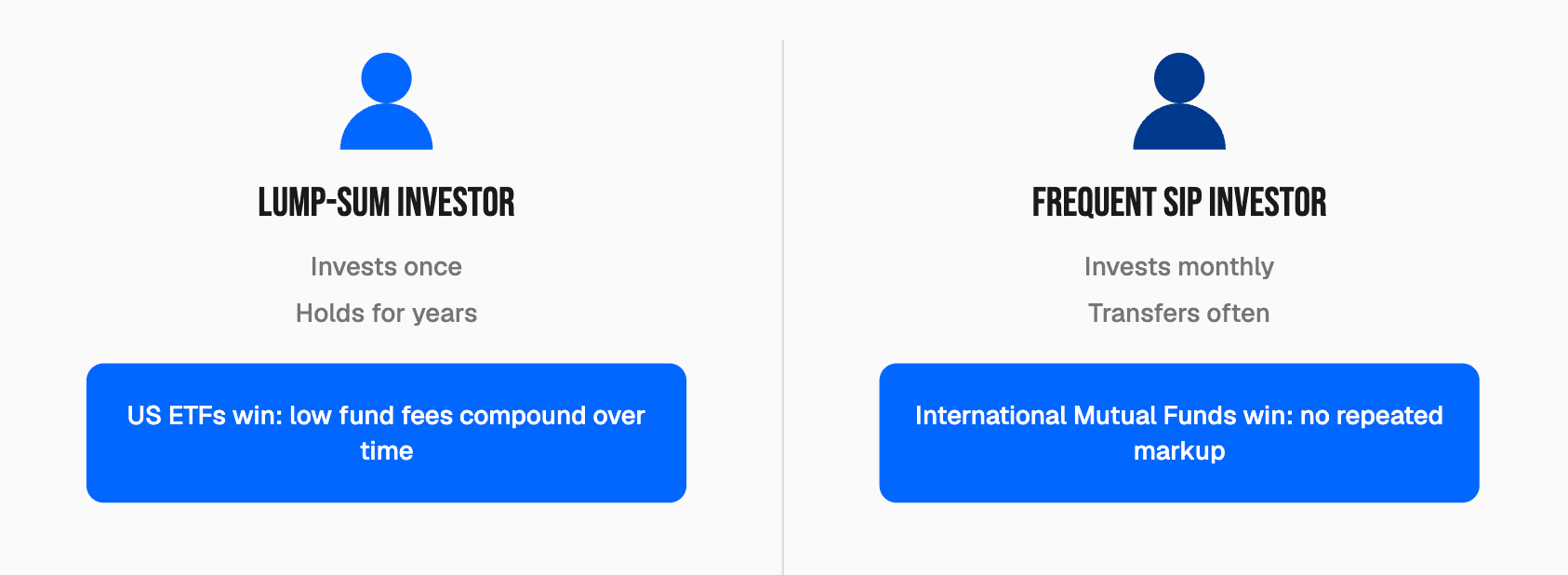
A lump-sum investor invests once and holds ten years. The markup is paid twice across the whole holding, a small one-off drag. What dominates is the annual expense ratio, so the lowest-fund-cost route wins, pointing to the offshore ETFs.
A SIP investor contributes monthly for years. The markup and any fixed transfer fee hit every transfer, twelve times a year, so a route with a high markup bleeds him regardless of fund cost. What dominates is the per-transfer cost. So the onshore rupee route, with no markup or wire fee per contribution, can win despite a higher expense ratio.
Be honest about how you invest: lump sum or regular, held long or traded, large or small amounts, and how likely you are to switch later. Then, for each route, add the whole stack for that pattern: the markup on every transfer you will make, the expense ratio (both layers if a FoF), brokerage and withdrawal fees as they apply, transfer fees against your size and frequency, and the switching cost. The lowest total for your pattern is your cheapest route.
One question. Less than 10 seconds.
Reinforce what you've learned before continuing to the next chapter.






Discussion