
Global investing carries costs beyond what's shown on any statement, hidden in your exchange rate, layered inside a fund, or absorbed by a platform recovering its "zero fee." This module teaches you to spot every hidden cost and add them into one honest number, because the route that looks cheapest on paper often isn't the cheapest for how you actually invest.
FX markup hid inside a rate and expense ratio hid inside a fund. This chapter is about the costs that live inside the platform you invest through, and it approaches them from an unusual angle. How does this platform actually make its money?
A platform that gives you access to global markets is a business, and businesses have to earn. So a platform always makes money somewhere.
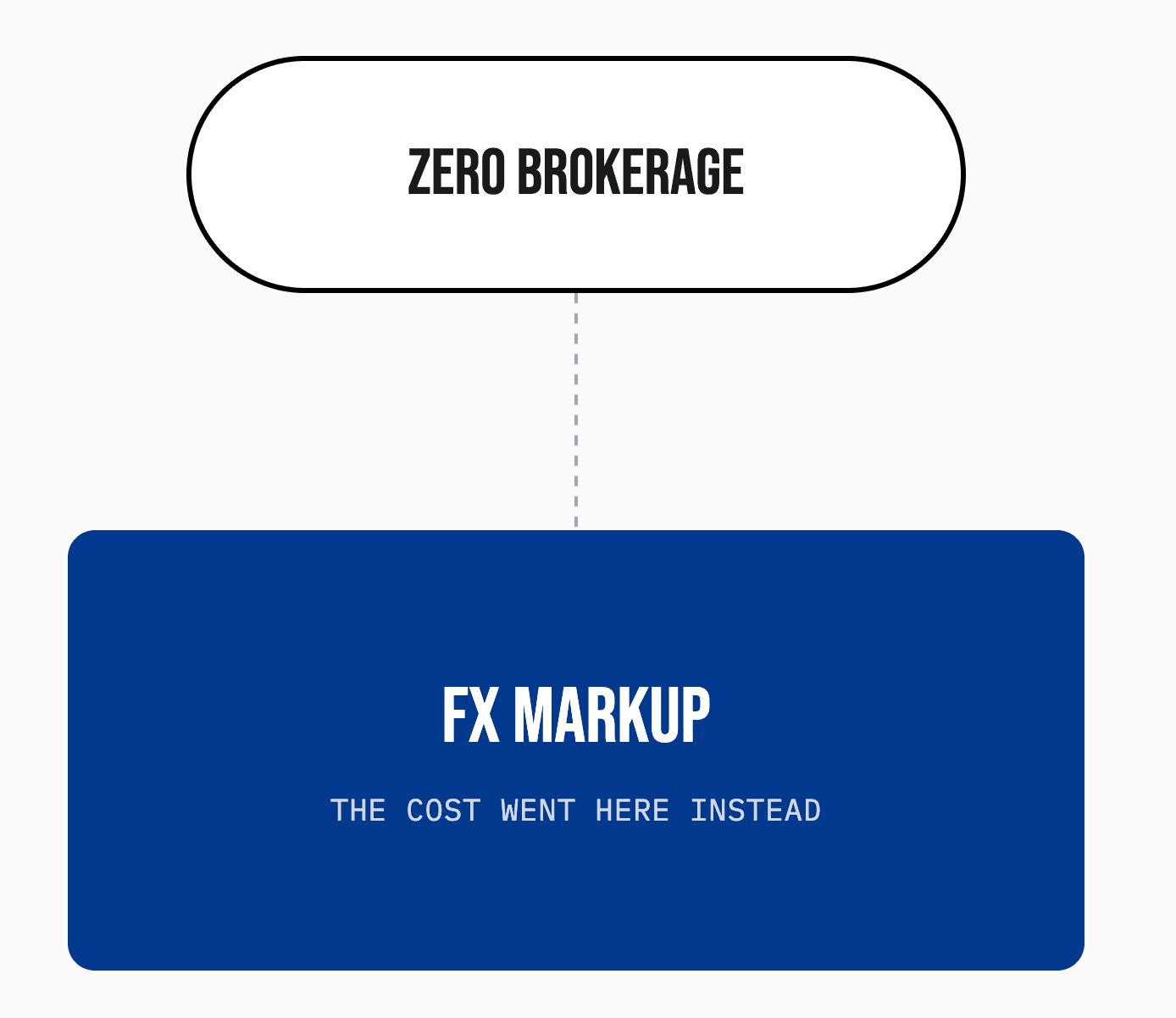
This matters because platforms compete on headlines, and the easiest headline to advertise is a zero. "Zero brokerage." "Zero account fees." "Free transfers." Each of these can be perfectly true, and each can also be entirely beside the point, because a platform that has zeroed out one visible charge has simply moved its earnings to a less visible one.
There are really only a handful of places a platform can earn.
The most straightforward place a platform earns is brokerage, the fee for executing a trade when you buy or sell.
Some platforms charge a percentage of the trade value, commonly around 0.25%, often with a ceiling so that large trades are capped. Some charge a flat fee per trade. And some charge nothing at all for brokerage.
A platform can proudly wave a "zero brokerage" banner while quietly taking a fatter cut on currency conversion than a competitor. The investor who compares only brokerage picks the "free" platform and pays more overall, through a cost they never checked.
There may be an account maintenance or annual fee simply for holding the account. There may be a withdrawal fee each time you take money out, sometimes a flat charge of several dollars per withdrawal. There may be an inactivity fee, or a minimum balance requirement. None of these is universal, and many good platforms charge none of them, but the point is that they exist and vary, so they must be checked rather than assumed.
When you remit, there can be a bank wire or SWIFT transfer fee, sometimes a few hundred to over a thousand rupees per transfer, and some banks add a fixed remittance charge on top. Certain routes avoid the traditional international-wire path altogether and carry lower transfer costs, while others pass through correspondent banks that each take a small cut. A flat fee is trivial on a large lump sum but punishes on a small monthly SIP, where it can quietly consume a real percentage of each contribution.
To judge any platform, do not read its marketing, read its full fee schedule and answer four questions in order.
One question. Less than 10 seconds.
Reinforce what you've learned before continuing to the next chapter.






Discussion