Global investing carries costs beyond what's shown on any statement, hidden in your exchange rate, layered inside a fund, or absorbed by a platform recovering its "zero fee." This module teaches you to spot every hidden cost and add them into one honest number, because the route that looks cheapest on paper often isn't the cheapest for how you actually invest.
When you own an ETF or a mutual fund, you are paying an annual fee for it to be run, and unlike the currency markup, which you pay at the moment of transfer, this fee is deducted quietly, continuously, from inside the fund, so you never write a cheque and never see a charge.
You met the expense ratio, the TER, earlier in the course. In one line: it is the annual cost of running a fund, charged as a percentage of the money you have invested, deducted from the fund's value over the year rather than billed to you. If a fund has a 0.2% expense ratio and you hold 1 lakh in it, roughly 200 rupees is taken over the year, silently, from within.
Because the expense ratio is charged every year on your entire holding, its effect is not a small percentage, it is a small percentage compounded over your whole investing life. And the money taken as a fee is money that can no longer grow, so you lose not just the fee but everything that fee would have earned.
A comparison shows the scale. Imagine two investors who both invest the same amount in funds tracking the same index, earning the same underlying return, and hold for twenty years. The only difference is cost: one holds a low-cost index fund at 0.2% a year, the other a costlier active fund at 1.2% a year. That gap is just one percentage point, which sounds trivial. But applied every year, on the full and growing balance, for two decades, the cheaper investor ends up with a materially larger final corpus.
The lesson is important. On a long-term holding, the expense ratio is one of the most important details.
Some funds do not hold companies directly. They hold another fund. You met this as the Fund of Funds structure earlier, and it matters enormously for cost.
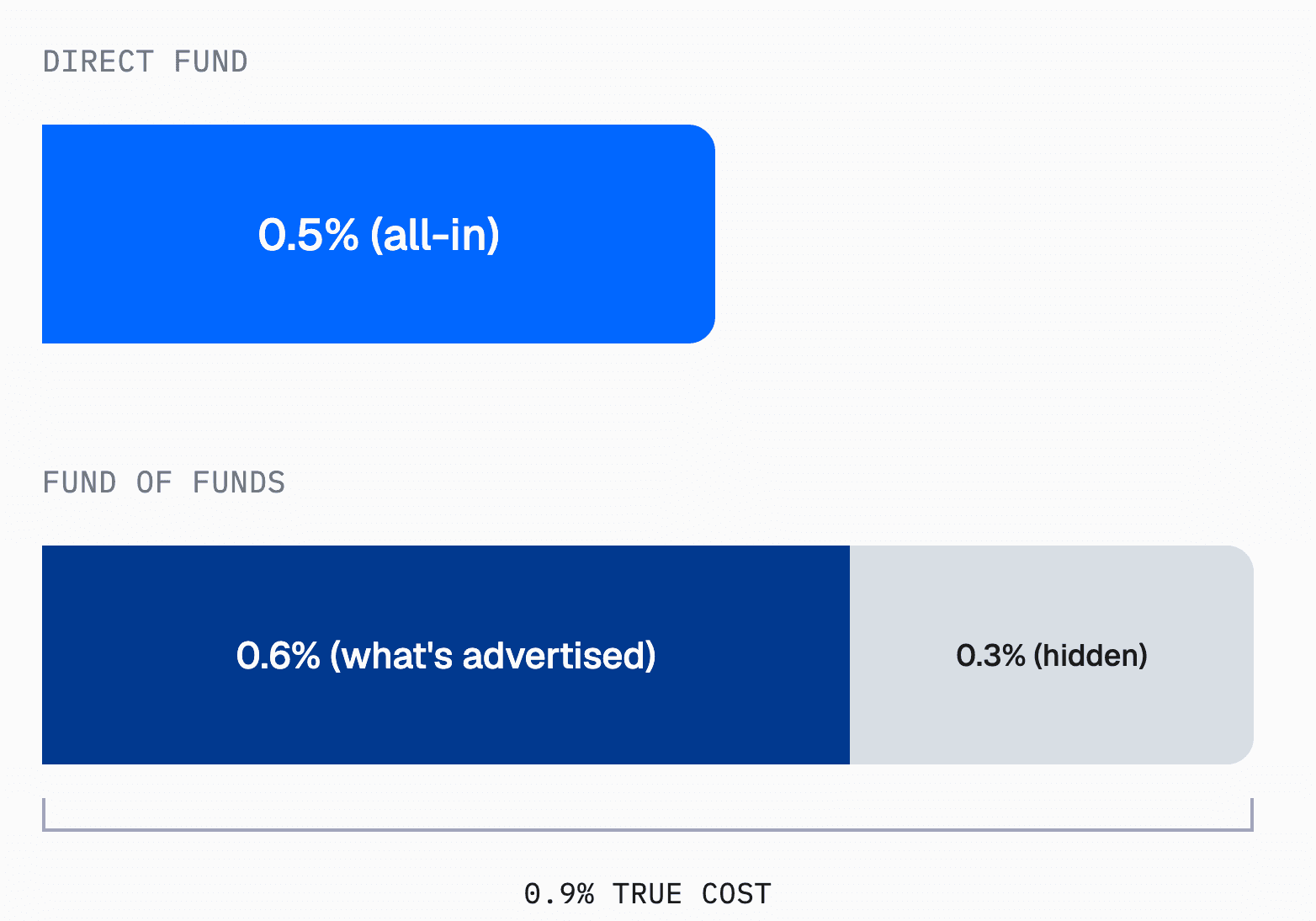
When a fund invests in another fund, there are two sets of running costs stacked on top of each other. The underlying fund charges its own expense ratio for managing its portfolio. And the fund sitting on top charges its own expense ratio for the wrapper it provides. The danger is that the number you are shown may not include the cost of the underlying fund at all.
Consider two ways to own the same US index exposure. The first is a single, directly investing fund with an all-in expense ratio of, say, 0.5%. The second is a Fund of Funds: the underlying US fund charges 0.3%, and the Indian wrapper on top charges another 0.6%, for a true combined cost of around 0.9%. On the shelf, the second might advertise only its own 0.6% and look competitive.
Whether a fund accumulates or distributes its dividends is usually discussed as a tax matter, but it has a cost dimension too. An accumulating fund reinvests dividends inside itself, automatically and at no extra transaction cost to you. A distributing fund pays them out, and if you then want that money reinvested, doing it yourself can incur fresh costs, another conversion, another brokerage charge, and often a delay before the money is back at work.
One question. Less than 10 seconds.
Reinforce what you've learned before continuing to the next chapter.






Discussion