Global investing carries costs beyond what's shown on any statement, hidden in your exchange rate, layered inside a fund, or absorbed by a platform recovering its "zero fee." This module teaches you to spot every hidden cost and add them into one honest number, because the route that looks cheapest on paper often isn't the cheapest for how you actually invest.
Of all the costs of investing abroad, this is the largest, the most frequent, and the one you're least likely to ever see. This chapter breaks down the currency markup, the gap between the real exchange rate and the one you're actually given, and why it quietly costs more than any fee you'll ever notice.
You cannot control what markets do, but you can control what you pay to participate in them. The trap is that the costs that matter most are often the ones that never appear as a fee at all. Currency conversion is the clearest example, so we begin there.
You invest in rupees, but foreign assets are priced in dollars, euros, or pounds. So every time money crosses over, it has to be converted, from rupees to dollars when you invest, and back from dollars to rupees when you eventually withdraw. Conversion is unavoidable. What is avoidable is paying more for it than you need to, and to do that you first have to see the cost at all.
There is a single real exchange rate at which currencies genuinely trade against each other at any moment. It is called the mid-market rate, and it is the one you see when you type "USD to INR" into a search engine. Your bank or platform quotes you a slightly worse rate, and keeps the difference. That difference is the currency markup, and it is a cost even though no line item ever says "fee."
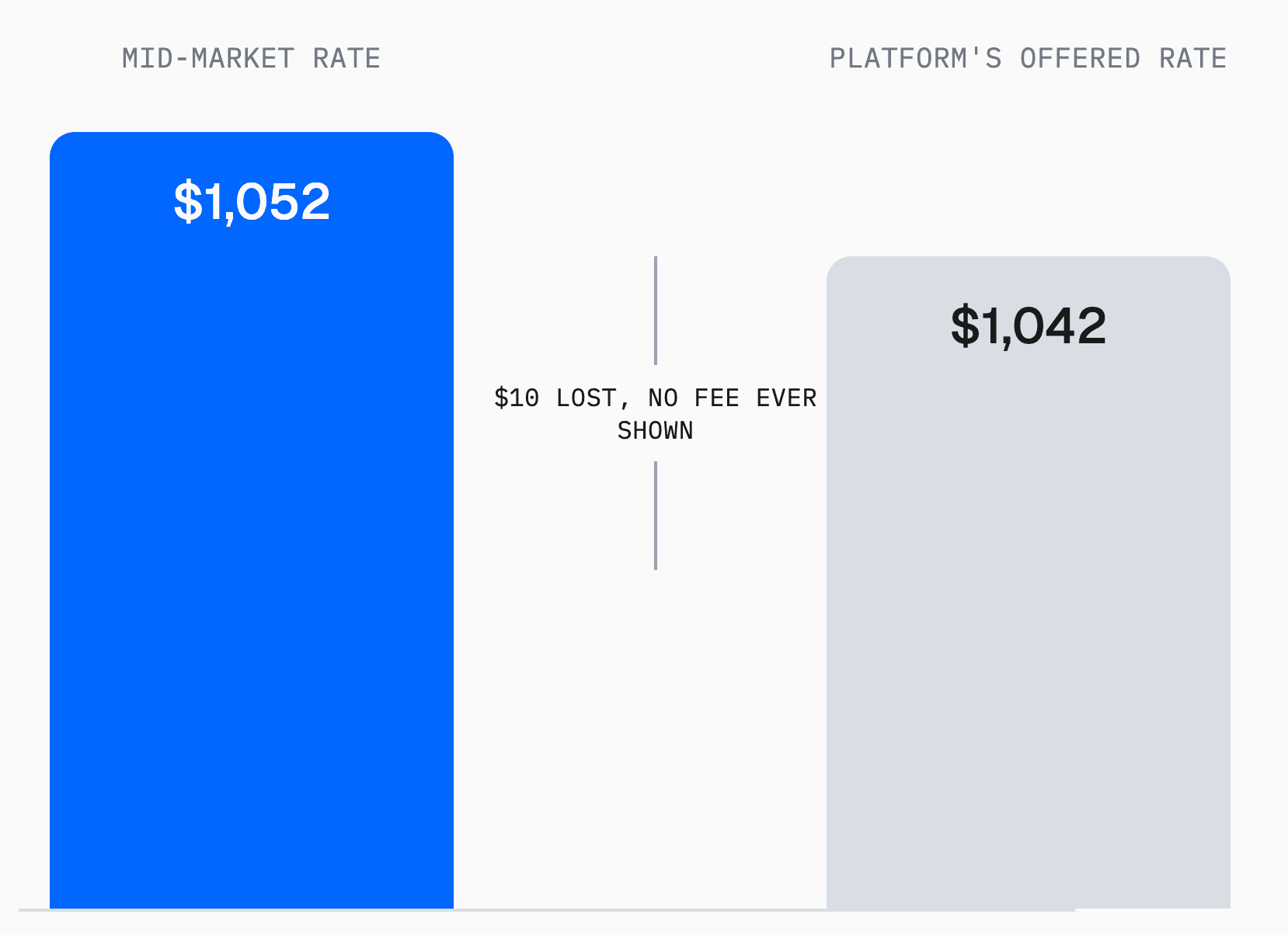
Suppose the real, mid-market rate is 95 rupees to the dollar, and you remit 1 lakh rupees to invest abroad. At the true rate, your 1 lakh should become about 1,052 dollars. But your bank does not give you the true rate. It applies a markup of, say, 1%, so your effective rate becomes about 95.95 rupees per dollar. At that rate, your 1 lakh becomes roughly 1,042 dollars instead of 1,052.
You have lost about 10 dollars. You simply received fewer dollars than the real rate would have given you, and the gap, the 10 dollars, went quietly to the bank.
Typical markups in practice run from around 0.5% to 1.5%, and at some banks up to 2%, depending on the bank, the amount, and the route you use. That range is the single most important number in this chapter, because it applies to money moving in both directions.
The example above was only the inbound leg, rupees to dollars, when you invest. But your money makes a round trip. One day you will sell and bring it home, converting dollars back to rupees, and the markup applies again on the way out.
So over the full life of an investment, you pay the currency markup twice: once entering, once leaving. If you pay 1% each way, that is roughly 2% of your capital gone to conversion alone, before a single other cost, and before the investment has done anything. On a 5 lakh investment, a rough total cost of getting in and out, driven mainly by this markup, can run into several thousand rupees.
If you invest through a SIP, sending money abroad every month rather than in one lump, the markup is charged on every single transfer. Twelve transfers a year means twelve markups a year, every year you keep investing.
Because this cost is hidden, the whole skill is learning to make it visible, and that turns out to be simple. The habit is to stop looking at fees and start looking at the rate. Before you transfer, check the mid-market rate on a quick search, then look at the rate your platform is actually offering you. The gap between them, expressed as a percentage, is your true currency cost, regardless of what the platform advertises about fees.
A platform proudly charging "zero fees" can still be giving you a poor rate and quietly earning more than a platform that charges an honest, visible fee.
It also makes sense to convert your INR to USD in large chunks instead of small, frequent tickets. This is suggested as some platforms tend to provide a slightly better rate on larger amounts. Look for a platform that allows you to convert your INR to USD and keep them handy for an SIP-style investing.
One question. Less than 10 seconds.
Reinforce what you've learned before continuing to the next chapter.






Discussion