
This module builds the foundation: why an Indian investor might look beyond home, and the core concepts, asset classes, products, and everything else that turn global investing from a wall of jargon into something you can read with confidence.
This chapter lays out the real reasons to look beyond home, from spreading risk to owning the companies shaping the future, so you can decide for yourself.
Investing is how money grows faster than it would sitting in a bank account. Most people in India do this through Indian companies, and for a long time, that was really the only practical option.
That is no longer true. Investing abroad means owning a piece of companies across the world, not just India, businesses listed in the US, Europe, and parts of Asia. It used to require serious money, a relative abroad, or paperwork most people had neither the patience nor the access for. For a long time, it simply was not something an ordinary Indian investor did. That has changed, and it is now a few taps away for almost anyone.
Today, more and more Indians are beginning their global investing journey. This chapter takes you through the 5 major motivating factors behind this.
1Indian markets are a small part of the world
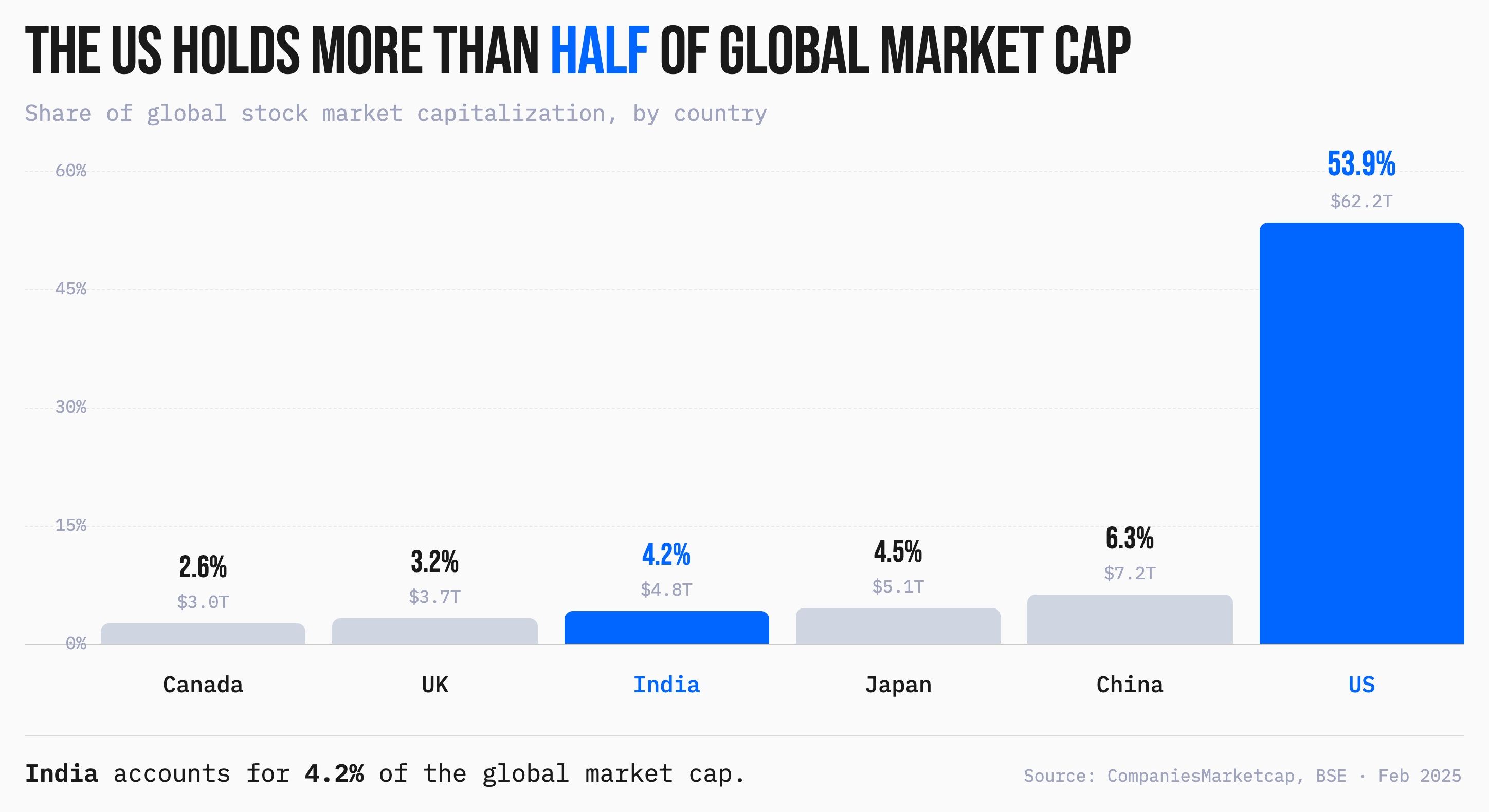
India has one of the largest stock markets in the world, and yet it still makes up only a single-digit share of the world's total market value. The United States alone is roughly half.
Own only Indian stocks, and almost your entire financial future rides on one country doing well, one currency staying strong, one government making good decisions, usually without ever having decided to take that bet. Spreading your money across other economies, so that one bad patch anywhere does not sink your whole portfolio, is called diversification.
It is worth pausing to look at what you already own. How much of it depends on India alone? If the answer is most of it, that is the imbalance diversification is meant to fix.
2Many of the biggest companies are not listed in India
Artificial intelligence, advanced semiconductors, electric vehicles, space, large-scale cloud computing. The industries defining the next twenty years are mostly led by companies listed in the US, China and other foreign markets, not India. If you want a stake in what is actually shaping the future, Indian exchanges alone will not get you there.
It is not just the unfamiliar names either. Your phone, the apps on it, and the chip running them all trace back to companies not listed in India. Apple, Google, Nvidia, Netflix, Microsoft, you use them every day, yet you cannot own a share of any of them through an Indian stock exchange.
Global investing closes both gaps: a piece of what comes next, and a piece of the companies you already know, listed somewhere other than India.

3The rupee has been weakening for years
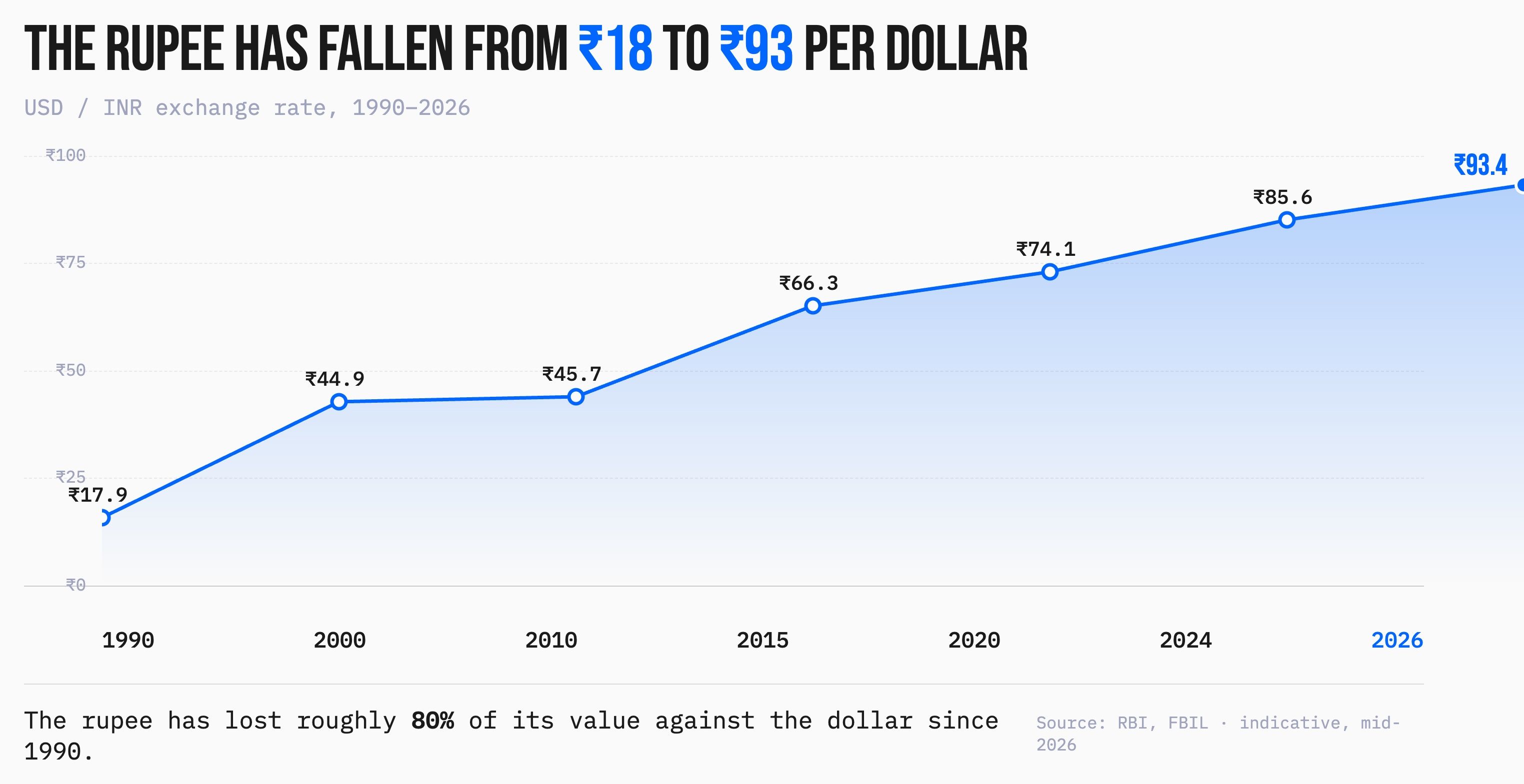
In 2010, one US dollar cost about 45 rupees. In 2026, it costs more than 90. Over the long run, the rupee has weakened against the dollar by roughly 3 to 4 percent a year.
A lot of what you spend on is, underneath, priced in dollars: foreign travel, a child studying abroad, imported electronics, fuel. As the rupee weakens, all of it gets more expensive in rupee terms. Holding some of your savings in dollars works in your favour exactly when that happens, because part of your money is sitting in the same currency as part of your future expenses.
This goes further than the occasional trip or a semester abroad. If there is any real chance you eventually work abroad, retire abroad, or move a part of your life there, even years from now, holding some dollar assets ahead of that means you are not forced to convert a large sum of rupees at whatever exchange rate happens to exist on that day. The rupee can strengthen for stretches too, and that is worth remembering, but the long-run direction has been consistent, and planning ahead of a need is usually cheaper than reacting to one.
4The US market has done well, and people have noticed
Over the last decade, the US market has delivered strong returns in dollar terms, and stronger still once rupee depreciation is added on top. People see this, hear about it from others, and want in.
That pattern is real. It is also just a decade, a short window in the life of any market, and performance that has already happened is not a promise of what comes next. This explains why a lot of people invest abroad. It does not, on its own, explain why you should.
5Most investors stick to what feels familiar
There is a well-documented tendency among investors everywhere, not just in India, to keep most of their money in companies from their own country simply because it feels familiar. It has a name: home bias. It shows up in the US, in Japan, in Europe, in every market that has been studied for it.
Recognising this in yourself is a reason in its own right. If the only reason your portfolio is entirely Indian is that it never occurred to you to look elsewhere, that is not a decision, it is a default. Spreading risk across economies is the financial argument for looking beyond India. This is the psychological version of the same idea, and often the real reason people never look past their home market in the first place.
Going global is not all upside, and it is fair to know the trade-offs before you begin. Currency can move against you too, not just in your favour, and that cuts both ways, so it deserves its own explanation later. Conversion costs a little. And you take on some extra tax and reporting work in India that a regular Indian mutual fund does not create. None of it is difficult, but none of it is nothing either, and all of it is worth understanding properly before you actually put money in. The chapters ahead cover each of these in turn.
One question. Less than 10 seconds.
Reinforce what you've learned before continuing to the next chapter.







Discussion