
Knowing what's out there isn't the same as knowing how much to own. This module covers portfolio construction end to end, how much should be global, US vs rest of world, bonds and commodities, funding, and rebalancing without losing money to taxes.
If predicting winners isn't the answer, what is? Modern Portfolio Theory, developed by the economist Harry Markowitz in the 1950s and tested across more than seventy years of market cycles since, offers a different premise entirely. Instead of trying to know which asset will do best, it asks how different assets behave together, and builds the portfolio from that.
Before Markowitz, the instinct in investing was straightforward: find the best assets, and hold them. MPT's insight was that this instinct, while reasonable-sounding, misses the more important question. The theory's core claim is that a portfolio's risk isn't simply the average of the risks of what it holds, it depends heavily on how those holdings move in relation to one another. Combine assets that respond to the world in similar ways, and their risks stack up. Combine assets that respond differently, and some of that risk cancels out, even without changing what you're holding or how much return you're aiming for.
This led to a genuinely different way of building a portfolio. Rather than asking "which asset is best," MPT asks "which combination of assets gives the most return for a given level of risk, or the least risk for a given level of return." The tool for answering that is what the theory calls the efficient frontier, essentially a map of the best possible portfolios you could build at every risk level, given how your chosen assets move together. You don't need to plot this yourself to use the idea. What matters is the underlying shift: the smart move isn't picking winners, it's engineering how your holdings relate to each other.
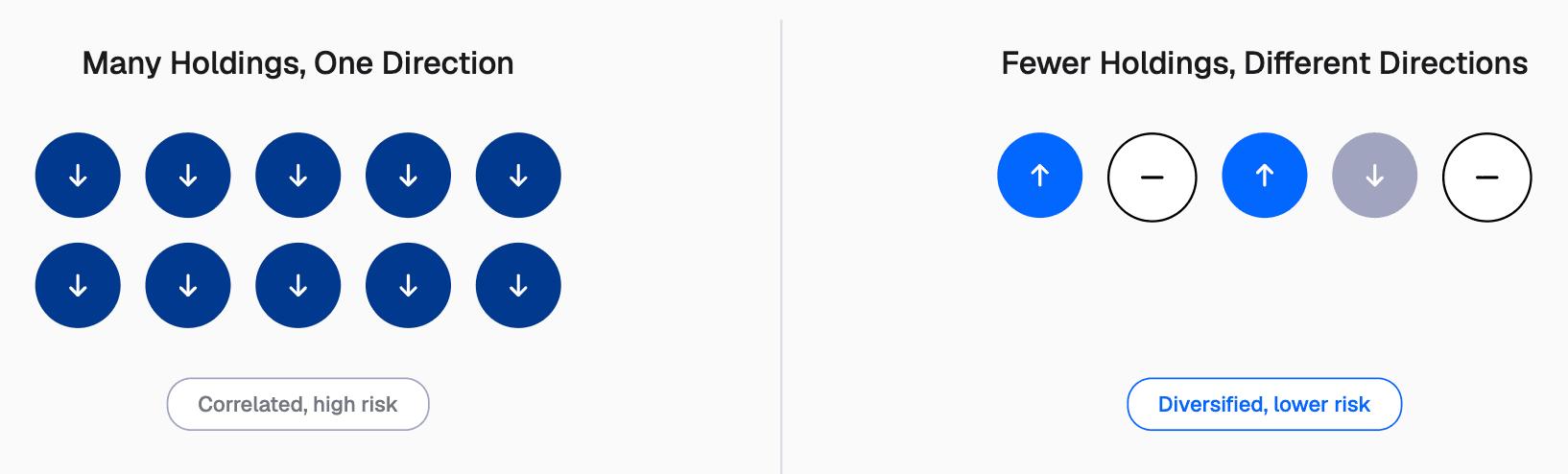
This is where MPT's insight becomes practical. It's tempting to think diversification simply means owning many things. It does not. A portfolio can hold twenty stocks and still be poorly diversified, if all twenty rise and fall together, responding to the same underlying forces. Owning more of the same kind of risk is not the same as spreading risk.
What actually matters is correlation, how assets respond to the same event. Some assets do well when the economy grows; others hold steady, or even gain, when markets are under stress. When you combine assets that behave differently rather than similarly, the portfolio as a whole becomes less fragile, not because any single holding is safer, but because they rarely fail you all at once. This is the real mechanism MPT describes, and it's why a thoughtfully built portfolio can control risk without simply giving up on return.
Once you accept that no one can reliably predict which asset wins next, a natural conclusion follows: rather than trying to select the winners, hold the whole market, and let the diversification itself do the work.
This is the case for passive investing. A passive fund tracks a broad index rather than betting on specific names, which means its return closely reflects the market it holds rather than any single manager's judgement. It also sidesteps the compounding cost problem from the last chapter almost entirely, since there is little buying and selling to trigger fees or tax along the way. Passive is not a lesser choice made for lack of skill. It is the structural conclusion of taking uncertainty seriously, and it follows directly from what MPT already told us: the goal was never picking winners, it was building the right combination.
The framework's proposal, in short, is this: stop trying to know which asset wins, and instead build a portfolio out of assets that behave differently from one another, held through low-cost, broad instruments rather than individual bets. That is the philosophy Modern Portfolio Theory hands us. What it does not yet tell you is how much of your money should sit where, and that practical question, starting with how much of your portfolio should be global at all, is where we turn to in the next chapter.
One question. Less than 10 seconds.
Reinforce what you've learned before continuing to the next chapter.





Discussion