
Knowing what's out there isn't the same as knowing how much to own. This module covers portfolio construction end to end, how much should be global, US vs rest of world, bonds and commodities, funding, and rebalancing without losing money to taxes.
The previous chapter settled roughly how much of your portfolio should be global. This chapter asks the natural follow-up: within that global slice, how much should go to the US specifically, versus everywhere else? For many investors, the honest starting instinct is simple, just buy the S&P 500 and be done with it. It's worth taking that instinct seriously before deciding whether to go beyond it.
The S&P 500 is genuinely an exceptional index. It holds many of the most valuable, most closely watched companies in the world, and it has compounded steadily for decades. It's also become remarkably hard to beat; markets have grown so efficient and closely tracked that even skilled professional managers overwhelmingly fail to outperform, year after year. So the instinct to lean heavily on the US isn't naive. It's backed by a real, well-documented track record.
There's a deeper reason the US can't simply be left out, though, and it goes beyond performance. US equities function as the anchor for world equities. Even a fund built to track the entire global market, the ACWI index, still holds roughly 65% of itself in US stocks. It's just what "the world's public companies, weighted by size" actually looks like today. So the question was never really whether to hold the US. Any genuinely global portfolio already does, heavily.
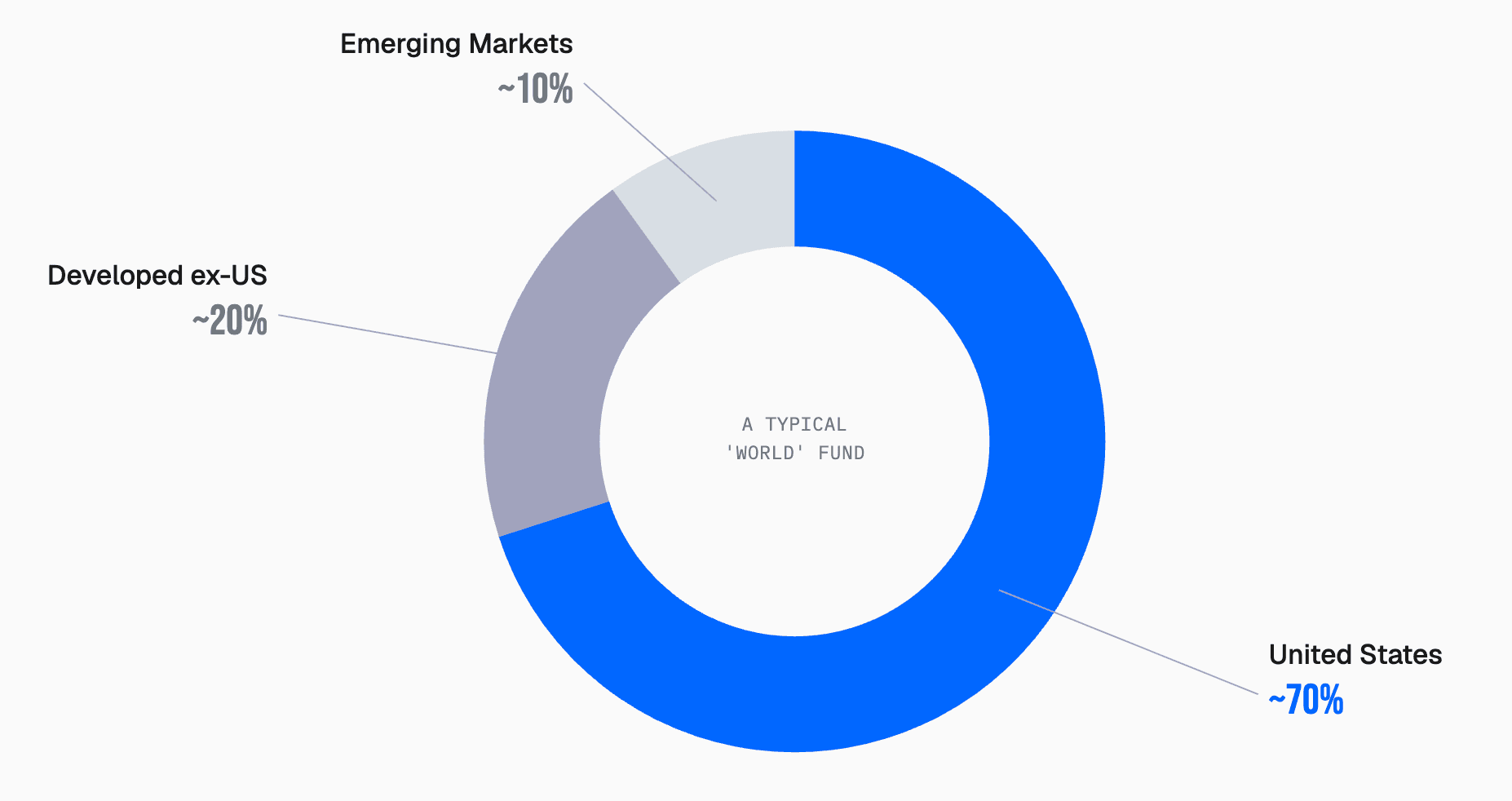
Even so, treating the US as your entire global allocation runs into the same problem you already met in Module 0, just one level up. Owning only Indian stocks means betting your future on one country. Owning only the S&P 500 as your global exposure makes almost the same bet, relocated rather than removed. It's still one country's economy, one currency, one regulatory environment, standing in for the rest of the world.
This shows up in a few concrete ways. The S&P 500 only covers large US companies, it says nothing about international businesses, other regions, or the sectors and industries that happen to be underrepresented on American exchanges. And your own need for this money doesn't stay constant either. Money you're building for a goal fifteen years out can comfortably sit in equities; the same money, three years from that goal, may need to shift toward something steadier. A single index, however excellent, doesn't flex to match either of those needs on its own.
None of this is an argument against the US. It will likely remain the largest single piece of most global portfolios, and for good reason, its depth, liquidity, and long-term track record are real. The argument is narrower: the US deserves to be your largest holding within your global allocation, not your only one.
In practice, this means treating your global slice the way you'd treat a diversified toolbox rather than a single tool. The US anchors it. Developed markets outside the US, and select emerging markets, sit alongside it, each responding somewhat differently to the forces that move the US on its own. You're not trying to guess which country wins next, you're making sure no single one, however impressive, can define your entire outcome if something goes wrong there specifically.
The US earns a large place in a global portfolio through genuine merit, not habit. But a large place is not the whole portfolio, and the same concentration logic that applies to India applies here too, just at a different scale. The next chapter looks at what actually sits in that remaining space, the developed and emerging markets beyond the US, and how to think about dividing your attention between them.
One question. Less than 10 seconds.
Reinforce what you've learned before continuing to the next chapter.






Discussion