
Knowing what's out there isn't the same as knowing how much to own. This module covers portfolio construction end to end, how much should be global, US vs rest of world, bonds and commodities, funding, and rebalancing without losing money to taxes.
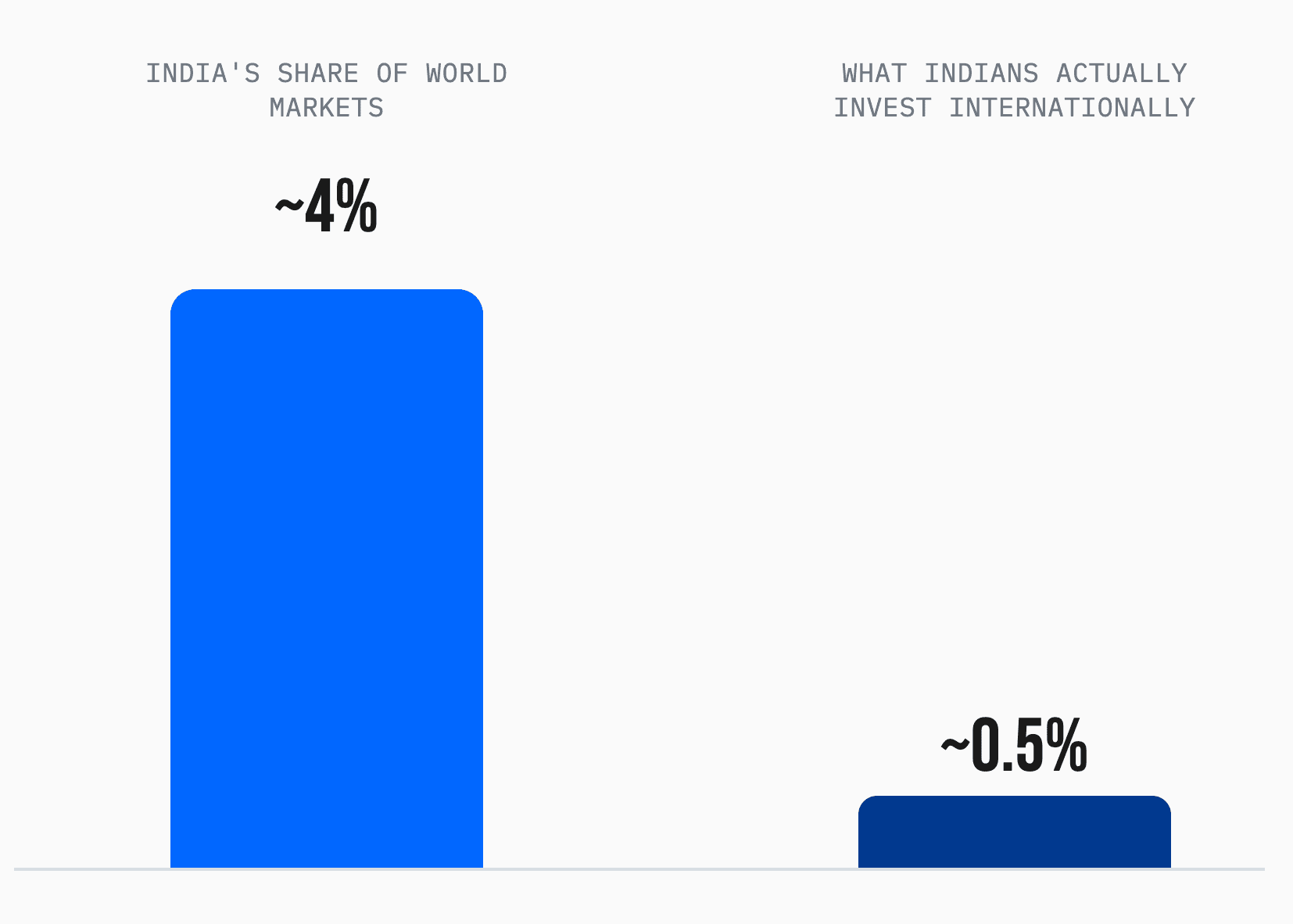
India makes up roughly 4% of the world's total stock market value. You'd expect Indian investors to hold something in that neighborhood internationally, if not more, given how easy global investing has become. The reality is starker. Research from S&P Dow Jones Indices puts the actual figure at around 0.5% of Indian portfolios held in international equities, functionally close to zero.
This is home bias in its most extreme form, not a mild tilt toward the familiar, but a near-total absence of the other 96% of the investable world. It isn't the result of a deliberate decision most people made. It's what happens when nobody makes a decision at all.
There's no single correct percentage that fits every investor, your goals, income stability, and how much of your life is already tied to India all shape the right number for you specifically. But it helps to have a working range rather than starting from zero.
A commonly used guideline is to direct roughly 20 to 30% of your equity allocation toward global markets. This isn't an arbitrary number. It's large enough to meaningfully reduce your dependence on a single country's economy, currency, and regulatory environment, while still keeping the bulk of your portfolio in the market you understand best and where most of your income and expenses are anchored.
A useful way to think about your own number is to ask how much of your life already depends on India. Someone earning in rupees, spending in rupees, and holding real estate in India is entirely exposed to the Indian economy before they've bought a single share. Someone who travels internationally often, has children likely to study abroad, or works for a global company already carries some natural exposure to dollar-denominated costs. For that second investor, a global allocation isn't just diversification, it's a hedge against expenses they can already see coming.
This is why the right global percentage isn't purely a function of risk tolerance. It's a function of how undiversified your life already is, and a 20 to 30% global allocation is the range where most investors start to genuinely correct for that, without overcorrecting into unfamiliar territory they're not ready to hold through a downturn.
You don't need to arrive at your exact number today. What matters is treating "how much should be global" as a real, deliberate decision; somewhere in the 20 to 30% range of your equity holdings is a sensible place to start thinking, adjusted up or down based on how exposed the rest of your life already is to India. The next question is where that global slice should actually go, and that's where we turn next: how much of it belongs in the US, and how much in the rest of the world.



Discussion