
Knowing what's out there isn't the same as knowing how much to own. This module covers portfolio construction end to end, how much should be global, US vs rest of world, bonds and commodities, funding, and rebalancing without losing money to taxes.
Global investing can be thought of as a puzzle with many pieces such as what to invest in, how to reach it, what it costs, how it's taxed. Upon finding the individual pieces, it becomes important to see the picture that emerges. Once you can invest globally, how do you decide what to hold, and how much of it?
Most people treat this as a search for the right answer, the best stock, the best fund, the best moment to buy. This is the wrong starting point, because it rests on an assumption that does not hold up: that you, or anyone, can reliably predict what comes next.
There is a real difference between a problem that is hard and one that is uncertain. A hard problem is vulnerable to effort, study more and your odds improve. Markets are not quite this. Prices move on information, sentiment, and events that cannot be forecast with any real consistency. A war can start, a company can miss earnings, a central bank can surprise everyone, and no amount of preparation removes that, it only prepares you to react to it.
This changes what a sound investing approach should even look like. If markets were merely hard, the goal would be more information. Because they are uncertain, the goal has to be building something that survives being wrong sometimes, rather than something that assumes you will always be right.
Suppose you genuinely do have skill at picking stocks. Even then, a difficult fact works against you: a single good call does not compound on its own. You have to be right about which stock to buy, when to buy it, and when to sell it, repeatedly, for years, without a losing streak long enough to undo the gains. Professional fund managers, whose full-time job is exactly this, illustrate how hard this bar actually is, sustaining outperformance across market cycles is difficult even for specialists with research teams behind them.
And every attempt to be right again carries a cost. Each trade invites a transaction cost, and each sale that produces a gain invites tax, whether you meant to trigger it or not. You have met this idea already, in the chapters on costs and capital gains. A strategy has to be good enough to overcome its own friction before it is worth pursuing at all, and frequent, individually clever decisions rarely clear that bar over a long enough horizon.
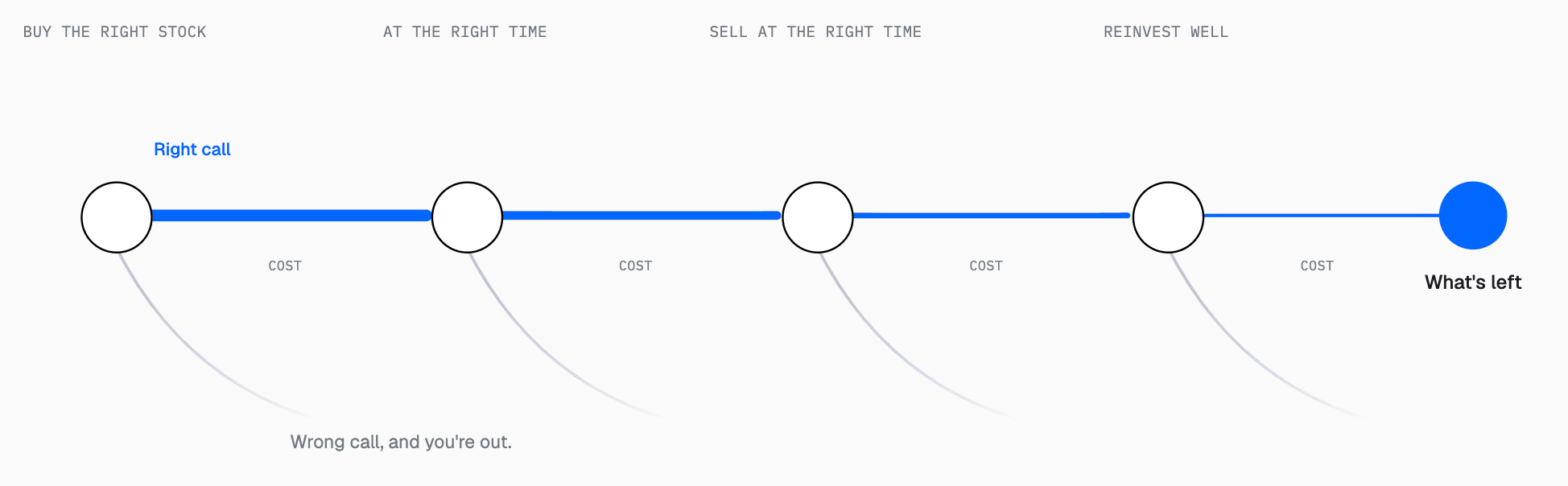
None of this means individual stocks are bad, or that skill doesn't exist. It means a portfolio built on the assumption that someone can reliably predict what comes next is built on a foundation that does not hold up, not from bad luck, but from the basic mathematics of uncertainty, repeated decisions, and compounding cost.
This is the diagnosis. It raises the natural next question: if predicting winners isn't the answer, what is? The next chapter takes that up, starting from a different premise, not trying to know which asset will do best, but building a portfolio that does not need to know.
One question. Less than 10 seconds.
Reinforce what you've learned before continuing to the next chapter.





Discussion