



The U.S. healthcare sector stands at an inflection point. Demographic shifts, scientific breakthroughs, and expanding treatment paradigms are converging to create one of the most compelling investment opportunities of this decade.
With healthcare spending projected to reach $6.8 trillion by 2030 and the 65+ population set to comprise 21% of Americans, the longevity economy is transitioning from niche concept to mainstream reality.
This analysis examines the structural drivers behind healthcare's next growth phase, identifies the most promising investment opportunities across market capitalizations, and presents data-backed insights for positioning portfolios in this secular trend.
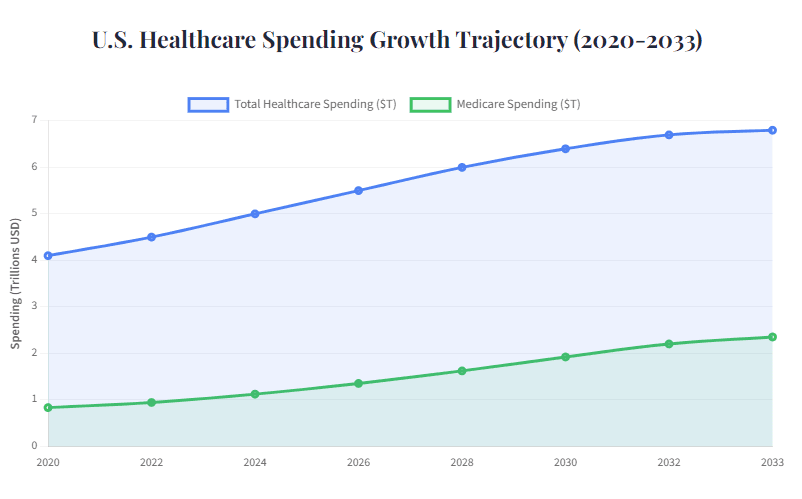
The numbers tell an unambiguous story. By 2030, every baby boomer will have crossed the 65-year threshold, creating an unprecedented surge in healthcare utilization. Per capita spending for those 65 and older reaches $22,356 annually, over five times higher than for children and 2.5 times that of working-age adults.
Medicare enrollment is accelerating at 7.8% annually through 2033, the fastest rate among major payers. Federal spending on healthcare programs will expand from 6.6% of GDP in 2020 to 9.2% by 2050, driven not just by population aging but by the increasing complexity of care required as patients live longer with chronic conditions.
Table of contents
- Key Growth Drivers
- Large-Cap Conviction Ideas
- Small-Cap Conviction Ideas
- Risk Considerations and Portfolio Construction
- Conclusion
Key Growth Drivers
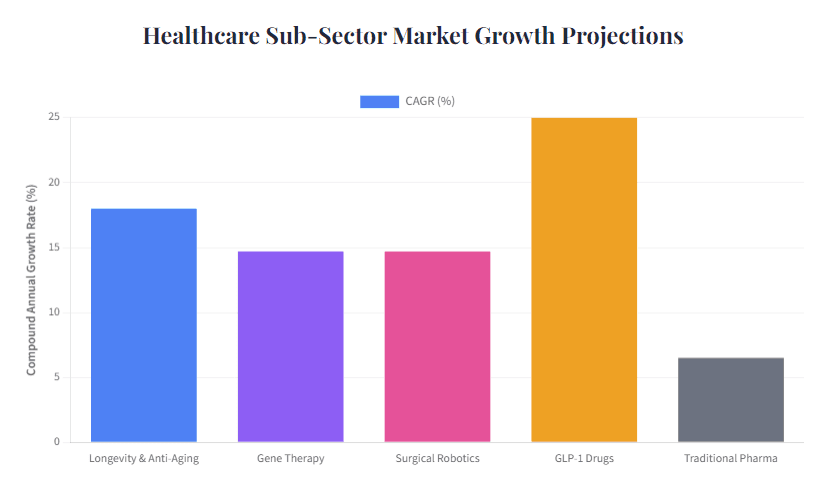
- Gene Therapy Revolution: The FDA approved three transformative cell therapies in December 2025 alone. The gene therapy market is expanding toward $36.55 billion by 2032, powered by curative treatments that address genetic diseases at their source rather than managing symptoms.
- Robotic Surgery Expansion: The surgical robotics market is growing from $13.69 billion in 2025 to $27.14 billion by 2030 (14.7% CAGR). Intuitive Surgical maintains 60% market share, but the addressable market is expanding as robotic systems penetrate ambulatory surgical centers and new specialty applications.
- Weight Management Megatrend: GLP-1 drugs represent a paradigm shift in metabolic health. Analysts forecast peak annual sales for tirzepatide alone could exceed $60 billion by 2030, with the broader obesity treatment market supporting multiple blockbuster franchises.
Market Opportunity: From Longevity Theory to Multi-Billion Dollar Reality
Large-Cap Conviction Ideas
Investment Rationale:
These established players offer the ideal combination of immediate exposure to secular growth trends and downside protection through diversified revenue streams. Eli Lilly and Vertex represent pure-play theses on transformative drug franchises with multi-year growth runways. Their pricing power, regulatory moats, and expanding addressable markets justify premium valuations.
Intuitive Surgical exemplifies the power of installed base economics in medical devices. With 60% market share and 85% recurring revenue, the company benefits from network effects as more surgeons train on da Vinci systems and hospitals integrate robotic platforms into standard surgical workflows.
Company | Ticker | Key Thesis |
Eli Lilly | LLY | Dominant GLP-1 franchise (Mounjaro, Zepbound) with Q3 2025 revenue up 54% YoY. Combined drug sales reached $10 billion. The pipeline includes oral formulations and Alzheimer's treatment Kisunla. Projected 32% revenue growth to $58-61B in 2025. |
Vertex Pharmaceuticals | VRTX | Monopoly in cystic fibrosis with $12B annual revenue run rate. IP protection through the 2030s. Casgevy (gene therapy) achieving $100M+ revenue. Journavx pain medication prescriptions are expected to triple in 2026. Expanding beyond CF into multiple therapeutic areas. |
Novo Nordisk | NVO | Co-leader in the obesity market with Wegovy/Ozempic franchise. Strong pipeline in metabolic health. European presence provides geographic diversification. Trading at attractive valuation following recent volatility. |
Intuitive Surgical | ISRG | 11,000+ da Vinci systems installed globally. 85% recurring revenue from instruments and services. Procedure growth of 13-16% annually. Da Vinci 5 launch expands addressable market. Strong moat from surgeon training and hospital workflow integration. |
Small-Cap Conviction Ideas
Investment Rationale: The small-cap segment offers asymmetric risk-reward profiles for investors willing to accept higher volatility. CRISPR Therapeutics stands apart with an already-approved product generating revenue, providing validation that other gene editing companies still seek. The $1.7 billion cash position eliminates near-term financing risk while multiple pipeline candidates offer optionality.
These companies are addressing markets where traditional pharmaceuticals have failed. Gene therapies that offer functional cures for genetic diseases can command premium pricing—Casgevy costs over $2 million per treatment yet remains cost-effective given its one-time administration and elimination of lifetime disease management costs.
Company | Ticker | Key Thesis |
CRISPR Therapeutics | CRSP | First FDA-approved CRISPR therapy (Casgevy) for sickle cell disease and beta-thalassemia. $1.7B cash position. CTX211 for type 1 diabetes in early trials. Gene editing market growing at 14.7% CAGR to $13.5B by 2033. Strong partnership with Vertex on Casgevy commercialization. |
Beam Therapeutics | BEAM | Pioneering base editing technology ("molecular pencil"). BEAM-302 reached FDA alignment on accelerated approval pathway for AATD. Four base-editing therapies in clinical development. $1.25B cash with runway into 2029. Differentiated approach to gene editing. |
Intellia Therapeutics | NTLA | First to demonstrate systemic in vivo CRISPR editing in humans. Nexiguran ziclumeran in Phase 3 for ATTR amyloidosis. Partnership with Regeneron. Three potential commercial launches before 2030. Cash runway through H1 2027. |
Anika Therapeutics | ANIK | Joint preservation and orthopedic care specialist. Regenerative Solutions revenue up 17% with 40%+ sequential growth in Integrity Implant System. Hyalofast targeting a $1B U.S. addressable market with 2026 launch. Expertise in hyaluronic acid applications.expands addressable market. Strong moat from surgeon training and hospital workflow integration. |
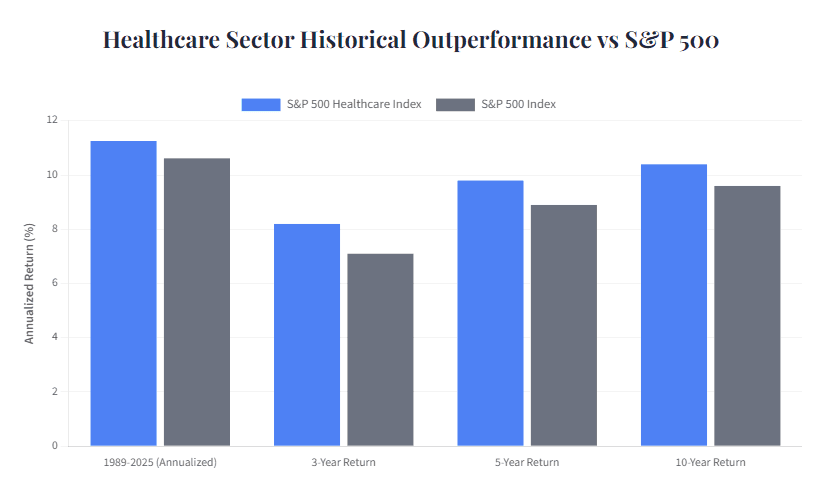
The S&P 500 Healthcare Index has delivered an annualized return of 11.26% since 1989, outperforming the broader S&P 500's 10.62% return. This consistent outperformance reflects healthcare's defensive characteristics combined with secular growth tailwinds.
Despite short-term headwinds in 2025, including policy uncertainty and company-specific challenges, the sector's fundamental drivers remain intact. Recent underperformance has created attractive entry points in quality names trading below historical valuation multiples.
Risk Considerations and Portfolio Construction
Healthcare investing requires acknowledgment of sector-specific risks. Regulatory pathways remain uncertain for novel therapies, with clinical trial failures capable of erasing billions in market value overnight. Pricing pressure from government negotiation (IRA provisions) will impact certain franchises, though innovation continues to support premium pricing for truly differentiated therapies.
Portfolio construction should balance these risks through diversification across therapeutic areas, technology platforms, and market capitalizations. A core position in established large caps provides stability and income, while selective small-cap allocations offer growth optionality. Position sizing should reflect individual risk tolerance and time horizon.
Conclusion
Healthcare spending will reach $6.8 trillion by 2030 because 67 million Americans will be 65 or older and require more intensive medical intervention. Gene therapies will capture growing market share because they address unmet needs in diseases where traditional drugs have failed. Robotic surgery will expand because it demonstrably improves outcomes while reducing costs.
The longevity revolution is not coming, it is here. The question is not whether to invest, but how to position portfolios to capture the opportunity while managing risks inherent in healthcare innovation. The data supports conviction. The fundamentals support allocation. The time to act is now.
Disclaimer
This article is intended for information only and does not constitute investment, tax, or legal advice. The material is based on public sources and our interpretation of current regulations, which may change. Investing in global markets entails risks, including currency risk, political risk, and market volatility. Past performance does not predict future outcomes. Please seek advice from qualified financial, tax, and legal professionals before acting.

