



Traditional equity and fixed income allocations, while foundational, represent only a portion of the investable universe. Alternative asset classes like commodities, and specialized derivatives offer unique return profiles, inflation hedges, and diversification benefits that can enhance portfolio resilience across market cycles.
For Indian investors, accessing these alternatives globally has historically been constrained by regulatory frameworks and brokerage limitations.
However, Paasa now provides Indian residents with direct access to US-listed alternative investment vehicles, opening doors to sophisticated portfolio construction previously available only to institutional investors or HNI clients with overseas accounts.
This guide examines the alternative asset landscape accessible to Indian investors, focusing on practical implementation through compliant investment vehicles.
Table of contents
- The Case for Alternative Assets
- Commodities: The Original Alternative
- Exotic Derivatives and Specialized Strategies
- Risk Management Principles
- Conclusion
The Case for Alternative Assets
Alternative assets exhibit low to negative correlation with traditional stock-bond portfolios, providing genuine diversification rather than merely adding more equity beta.
During the 2022 market drawdown, for instance, while the S&P 500 declined 18.1% and the Nasdaq fell 32.5%, commodities (as measured by the Bloomberg Commodity Index) gained 16.1%, demonstrating their defensive characteristics during inflationary regimes.
Key Benefits:
- Inflation Protection: Commodities and real assets tend to appreciate during inflationary periods when traditional bonds suffer
- Crisis Alpha: Gold and certain commodities have historically performed during equity market stress
- Return Enhancement: Commodity carry strategies can enhance portfolio returns, albeit with higher volatility
- Currency Diversification: Dollar-denominated alternatives provide natural INR hedge for Indian investors
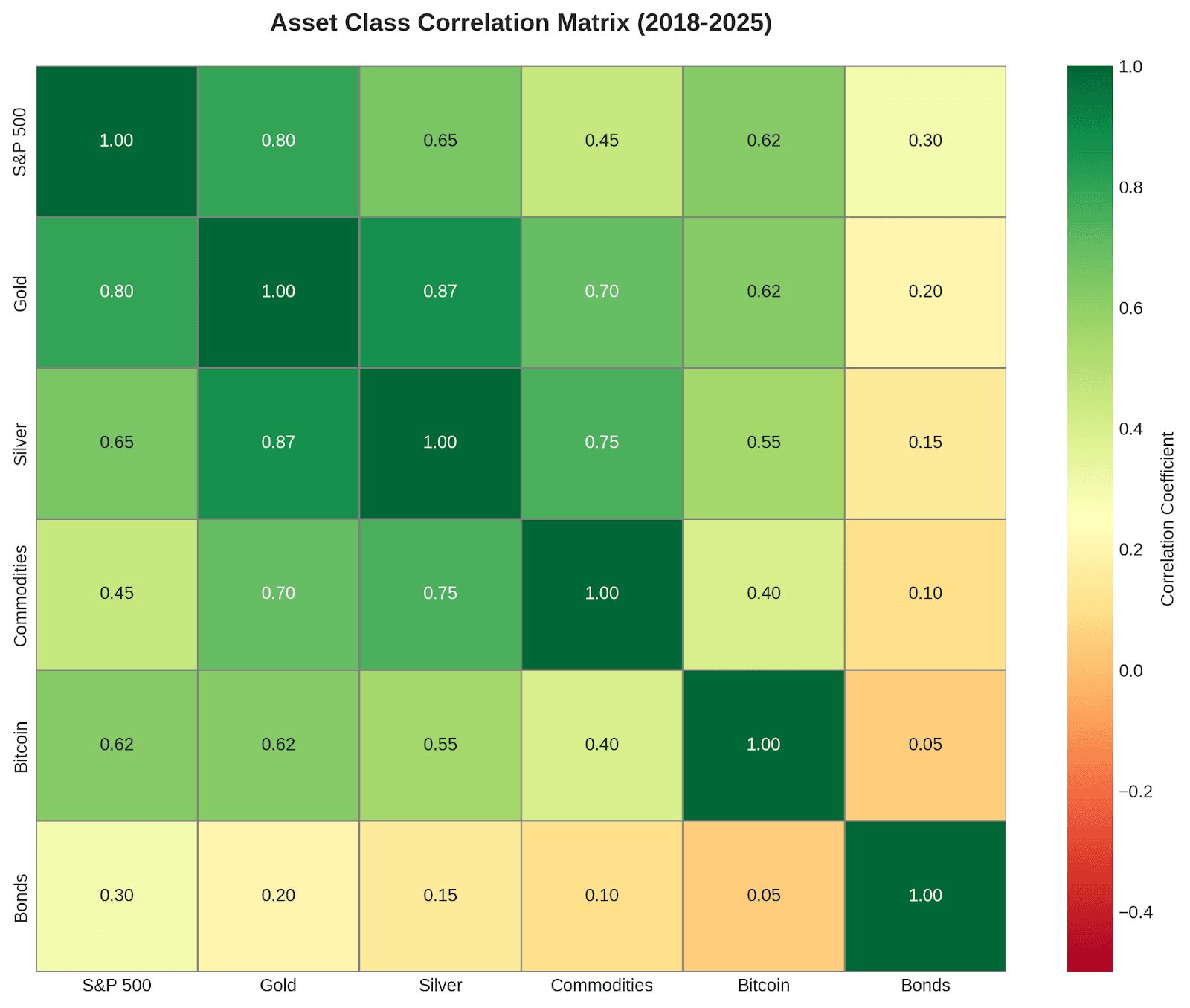
The correlation heatmap reveals fascinating relationships between alternative assets and traditional investments that are crucial for Indian investors building globally diversified portfolios. Correlation coefficients range from -1 (perfect inverse relationship) to +1 (perfect positive relationship), with 0 indicating no relationship.
- Gold demonstrates an 87% correlation with silver (the highest among all pairings) confirming that precious metals move largely in tandem due to shared monetary and safe-haven characteristics. This means investors seeking diversification should not simply load up on multiple precious metals, as they provide limited incremental diversification benefits.
- Commodities show moderate 70% correlation with gold but only 45% with stocks, making broad commodity exposure genuinely complementary to equity portfolios. This lower stock correlation explains why commodities provided positive returns (+19.34% via DBC) during the 2022 bear market when stocks fell 18%.
- Bitcoin's 62% correlation with both gold and stocks positions it as a hybrid asset, neither pure risk-on nor pure risk-off. This mid-level correlation suggests Bitcoin captures elements of both speculative growth (like tech stocks) and alternative currency characteristics (like gold), though with dramatically higher volatility.
Commodities: The Original Alternative
Commodities represent physical assets like energy, metals, agriculture with intrinsic value derived from industrial demand and scarcity. Unlike equities, commodities generate returns through price appreciation and roll yield (the return from rolling futures contracts), not cash flows or earnings growth.
Broad Commodity Exposure
Invesco DB Commodity Index Tracking Fund (DBC)
DBC provides diversified commodity exposure tracking the DBIQ Optimum Yield Diversified Commodity Index. The fund holds futures contracts across energy (55%), agriculture (27%), and metals (18%), with intelligent contract selection to minimize negative roll yield.
- Expense Ratio: 0.87%
- AUM: $1.2 billion
- Strategy: Actively selects futures contracts to optimize roll yield
Precious Metals: The Monetary Commodities
Gold and silver occupy unique positions as both industrial commodities and monetary alternatives, serving as stores of value during currency debasement and geopolitical uncertainty.
SPDR Gold Shares (GLD)
The largest physically-backed gold ETF, GLD holds actual gold bars in vaults, with each share representing approximately 0.09 ounces of gold. The fund provides direct gold price exposure without futures roll costs or storage concerns for individual investors.
- Expense Ratio: 0.40%
- AUM: $68 billion
- Backing: 100% physical gold held by HSBC Bank
iShares Silver Trust (SLV)
SLV offers physical silver exposure, tracking spot silver prices. Silver combines monetary characteristics with industrial demand (solar panels, electronics), creating different supply-demand dynamics than gold.
- Expense Ratio: 0.50%
- AUM: $11 billion
- Industrial Demand: 50% of silver consumption is industrial
Agricultural Commodities
Agriculture offers diversification from energy and metals while providing exposure to global food demand growth and weather-related supply shocks.
Invesco DB Agriculture Fund (DBA)
DBA holds futures contracts in corn, soybeans, wheat, and sugar, providing broad agricultural exposure with intelligent contract selection to manage roll yield.
- Expense Ratio: 0.89%
- Composition: Diversified across grains and softs
- Use Case: Inflation hedge and emerging market demand proxy
Industrial Metals
Copper, aluminum, and other base metals serve as economic activity proxies, with prices correlating to global manufacturing and construction cycles.
United States Copper Index Fund (CPER)
Copper exposure through futures contracts. Copper's high demand elasticity makes it a leading indicator for global growth, particularly Chinese infrastructure spending.
- Expense Ratio: 0.81%
- Economic Indicator: Copper prices often lead equity markets at cycle turning points
Exotic Derivatives and Specialized Strategies
Beyond traditional alternative assets, certain derivative-based strategies offer alternative risk premia unavailable through direct asset ownership.
Volatility Exposure
Volatility represents fear and uncertainty priced into options markets. While volatility indices like VIX cannot be directly owned, volatility-linked ETFs provide exposure to volatility futures.
ProShares VIX Short-Term Futures ETF (VIXY)
VIXY holds short-dated VIX futures contracts, providing exposure to equity market fear. This is fundamentally a hedging instrument, not a long-term holding—severe contango in VIX futures creates persistent decay.
- Expense Ratio: 0.85%
- Use Case: Short-term portfolio hedge during identified risk events
- Warning: Average -50 to -70% annual returns during calm markets due to contango
Important Note: Volatility products are sophisticated hedging tools, not investments. Indian investors should use these sparingly and only for defined-risk tactical hedges. Never allocate >1% portfolio value and never hold longer than necessary for the specific hedge objective.
Managed Futures Strategies
Managed futures funds employ systematic trend-following strategies across commodities, currencies, interest rates, and equity indices. These strategies profit from sustained directional moves in any direction.
iMGP DBi Managed Futures Strategy ETF (DBMF)
Implements trend-following across 75+ global futures markets using proprietary algorithms. Managed futures historically exhibit negative correlation to equities during severe drawdowns (2008, 2022).
- Expense Ratio: 0.85%
- Strategy: Quantitative trend-following
- Crisis Performance: +3.3% in 2022 while S&P 500 fell -18.1%
- Accessibility: Available to Indian investors; represents true portfolio diversifier
Risk Management Principles
Position Limits: Individual alternative positions should not exceed 10% of total portfolio unless investor has extraordinary conviction and risk tolerance.
Correlation Monitoring: Alternatives lose diversification value when correlations converge during systemic crises. The 2020 COVID crash saw gold, Bitcoin, and equities all decline simultaneously before eventually diverging.
Liquidity Requirements: Maintain 6-12 months expenses in liquid instruments before allocating to alternatives. These assets exhibit higher volatility and may need to be liquidated at inopportune times if needed for liquidity.
Cost Consciousness: Every 1% in annual expenses reduces terminal wealth by approximately 18% over 20 years (assuming 8% gross returns). Favor lower-cost ETFs when economically equivalent exposures exist.
Rebalancing Discipline: Alternatives can experience 2-3x moves within single years. Mechanical rebalancing prevents behavioral errors of adding to recent winners and abandoning recent losers.
Conclusion
Alternative assets like commodities and specialized derivatives provide diversification, inflation protection, and return enhancement opportunities distinct from traditional stock-bond portfolios.
The key to successful alternative investing lies not in maximizing allocation to these assets, but in thoughtful position sizing, cost management, and disciplined rebalancing. A 15-25% alternative allocation within a globally diversified portfolio can meaningfully enhance risk-adjusted returns while providing genuine crisis alpha during equity market drawdowns.
As with all investments, alternatives should complement, not replace, core equity and fixed income holdings. The investor's time horizon, liquidity needs, and risk tolerance should govern allocation decisions rather than short-term performance or trend-chasing.
For Indian investors ready to graduate beyond purely equity-focused global portfolios, the alternative asset universe offers sophisticated tools previously accessible only to institutional investors—now available through an app with regulatory compliance and institutional custody.
Disclaimer
This article is intended solely for information and does not constitute investment, tax, or legal advice. Global investments carry risks, including currency risk, political risk, and market volatility. Please seek advice from qualified financial, tax, and legal professionals before acting.

