



Markets move on headlines. A single tweet from a world leader can erase billions in market cap within minutes. Diplomatic tensions flare and traders rush to safe havens. But here's the uncomfortable truth: most of what dominates the news cycle is completely irrelevant to long-term investment outcomes.
The challenge isn't just filtering information. It's understanding which geopolitical developments fundamentally alter the trajectory of markets versus those that create temporary volatility and fade within weeks. Getting this right separates wealth creation from wealth destruction.
Table of content
- Understanding the Noise
- What Moves Markets
- Framework for Filtering Signal from Noise
- Structural Shifts Worth Watching
- The Humility Requirement
- Final Perspective
Understanding the Noise
Daily geopolitical theater dominates financial media for a simple reason: it drives engagement. Urgent language, breaking news alerts, and dramatic imagery capture attention. But attention and importance are not the same thing.
Consider the typical lifecycle of a noise event. Political rhetoric escalates between two nations. Markets sell off 2-3% in a day. Analysts publish urgent notes. Within 72 hours, the story fades. Markets recover. Repeat.
Typical Noise Characteristics
- Duration: 1-5 trading days
- Market Impact: 1-3% volatility
- Recovery Time: Less than 2 weeks
- Fundamental Change: None
Common Noise Triggers
- Political rhetoric without policy
- Military posturing that doesn't escalate
- Diplomatic incidents in minor economies
- Election polls months before voting
The pattern is remarkably consistent. Between 2015 and 2024, there were over 200 "market-moving" geopolitical headlines that generated same-day volatility exceeding 1%. Of these, fewer than 15 had lasting impacts beyond 30 days. That's a 92% noise rate.
Human psychology makes this worse. Recent events feel more significant than they are. The availability heuristic means whatever dominated yesterday's headlines feels like the most important thing in the world, even when historical precedent suggests it won't matter next month.
What Actually Moves Markets
Real geopolitical signals share common characteristics. It disrupts critical flows, threatens institutional stability, or fundamentally alters the balance of power. These aren't headline grabbers on day one. They're structural shifts that compound over time.
Energy and Commodity Disruptions
When Russia invaded Ukraine in February 2022, markets didn't primarily care about sovereignty or international law. They cared because the conflict immediately disrupted wheat, fertilizer, and energy flows that underpinned global food security and industrial production.
The price shock was immediate. European natural gas prices increased 10x. Wheat futures jumped 50%. But the signal wasn't just the price spike. It was the structural realization that energy dependence on geopolitically unstable regions carried catastrophic tail risk.
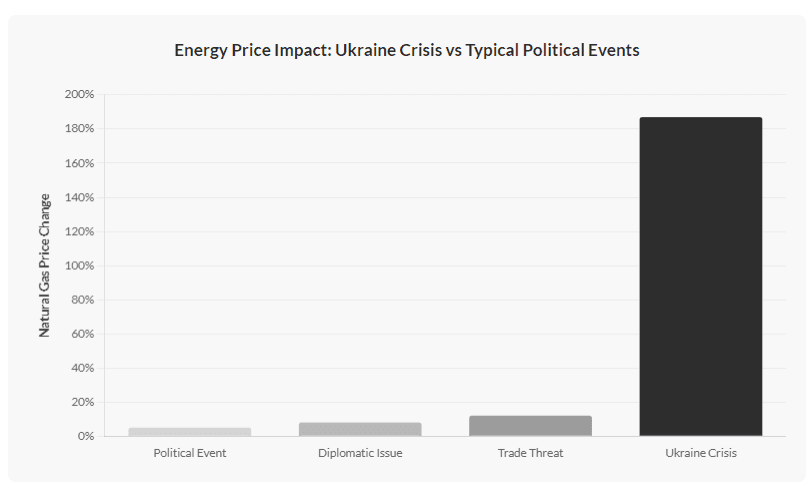
This forced a multi-trillion dollar reorganization of European energy infrastructure. LNG terminals, renewable acceleration, nuclear reconsideration. These decisions will shape markets for decades. That's a signal.
US-China Technology Decoupling
The gradual restriction of semiconductor technology transfers between the US and China represents one of the most significant geopolitical developments for markets in the 21st century. Yet it barely registers in daily market volatility.
The 2022 CHIPS Act and corresponding export controls didn't crash markets. They created a slow-motion reorganization of the global semiconductor supply chain worth hundreds of billions in capex investment. Companies like TSMC, Samsung, and Intel are building fabs in the US and Europe not for efficiency but for strategic security.
Key Insight: The US-China tech decoupling involves over $500 billion in announced semiconductor manufacturing investments through 2030. This isn't political noise. It's capital reallocation on a scale that reshapes comparative advantages between nations and companies for a generation.
For investors, this matters infinitely more than daily trade rhetoric. It determines which companies control critical technology nodes, where manufacturing capacity concentrates, and which nations maintain strategic independence in AI and advanced computing.
The Framework for Filtering Signal from Noise
Effective geopolitical analysis for markets requires a systematic approach rather than gut reactions to headlines. Here's what separates useful signal detection from reactive trading.
Does It Affect Cash Flows or Discount Rates?
This is the fundamental question. If a geopolitical development doesn't plausibly change corporate earnings or the risk-free rate environment over a meaningful timeframe, it's noise regardless of headline drama.
Tariff threats that never materialize don't affect cash flows. Sanctions with broad exemptions don't affect earnings. Political rhetoric without policy implementation doesn't change discount rates. Wait for actual economic impact before treating announcements as actionable.
Policy vs Politics
Politicians talk constantly. They act sporadically. The gap between announced intentions and implemented policy is where most investors lose money.
Trade negotiations involve months of threats, counter-threats, and dramatic statements. 90% of this is positioning. The 10% that matters is the final agreement and its implementation timeline. Everything else is noise designed to influence the negotiation.
Political Theater (Noise) Actual Policy (Signal) Speeches and statements Proposed legislation Enacted legislation Deployed military force Second and Third Order Effects
Markets chronically underestimate how geopolitical events cascade through interconnected systems. The direct impact is often trivial compared to downstream consequences.
The 2011 Fukushima disaster's direct economic damage to Japan was significant but manageable. The real market impact came from Germany's decision to phase out nuclear power, which increased European dependence on natural gas, which made them vulnerable to Russian leverage, which contributed to the 2022 energy crisis. The chain of causation took a decade to play out.
This is why reactive trading to immediate geopolitical events usually fails. The first-order effect is priced within hours. The second and third-order effects take quarters or years to emerge and are where actual mispricings develop.
Structural Shifts Worth Watching
- Supply chain regionalization: The move from efficiency-optimized global supply chains to resilience-optimized regional ones involves trillions in capex reallocation. This isn't a quarterly event. It's a decade-long reorganization of manufacturing geography.
- Energy transition geopolitics: The shift away from fossil fuels doesn't eliminate energy geopolitics. It changes the critical resources from oil to lithium, cobalt, rare earths. China's dominance in processing these materials creates new dependencies that could matter enormously.
- Taiwan contingency: The probability of conflict over Taiwan in the next decade is genuinely unknowable. But the market impact would dwarf Ukraine because Taiwan produces 90% of advanced semiconductors. This is binary: either noise (no conflict) or the most significant geopolitical event since World War II.
- Institutional decay in major economies: The gradual erosion of property rights, rule of law, and policy predictability in major economies matters more than dramatic events in minor ones. Capital flows to where it feels safe. Incremental institutional degradation can trigger sudden capital flight.
The Humility Requirement
Even the best frameworks fail because genuinely important geopolitical developments often look manageable initially. The invasion of Kuwait in 1990 seemed like a regional issue until it wasn't. The 2008 financial crisis started with subprime mortgages most people had never heard of.
Markets chronically underestimate tail risks until they materialize, then overestimate their duration. This creates systematic mispricings that are difficult to exploit because timing is nearly impossible.
The correct posture combines conviction about structural trends with humility about specific events. Be confident that energy transition will reshape geopolitics. Be humble about whether China invades Taiwan in 2027 or never. Build portfolios for the former. Don't trade the latter.
Final Perspective
The distinction between noise and signal in geopolitics isn't about predicting the future. It's about understanding which developments alter fundamental assumptions about how the world works versus which create temporary volatility.
Hedge Tail Risk, Don't Trade Headlines. The geopolitical events that genuinely devastate portfolios are rare but catastrophic. Energy crises, major wars, collapse of reserve currencies. These are worth hedging against not because they're likely but because their impact is asymmetric.
In an environment where geopolitical risk has genuinely increased from the post-Cold War baseline, maintaining this distinction becomes harder but more important. The signal to noise ratio may be rising, but it's still heavily skewed toward noise. Discipline in filtering remains the edge.

